Compare business credit cards for restaurant owners in 2026

Written byGabriel Vito

Reviewed by Robin Saks Frankel

Summary
- This guide is about the best business credit cards to operate a restaurant, not cards that reward you for eating at one.
- Most restaurant owners find their biggest expenses don’t qualify for the bonus categories on cards marketed to them.
- Four things determine which one fits your restaurant: whether your biggest vendors qualify for bonus categories, whether you need high limits or flexible spending capacity, what financing tools match your cash flow, and whether employee spend controls or accounting integrations are worth paying for.
- Before applying for anything, pull your last 60 to 90 days of transactions and map your top vendors to card reward categories. Then use this guide to find the card that fits how your restaurant runs.
Compare top picks at a glance
Card | Annual fee | Rewards type | Fits restaurant spend | Financing flexibility | Employee controls | Watch out for |
Capital One Spark Cash Plus For distributor & wholesale spend | $150 | Flat-rate | Captures all spend regardless of vendor coding | Pay in full / pay over time | Per-card spending limits; real-time transaction visibility | Annual fee waived only when you spend $150,000 or more per year |
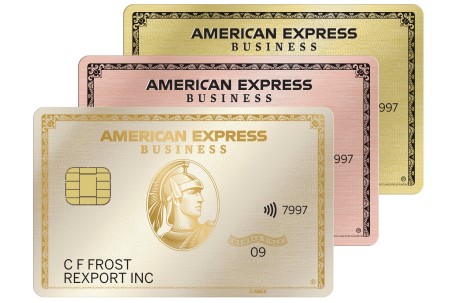
American Express® Business Gold Card For mixed monthly spend | $375 | Category | Auto-rewards top 2 categories each cycle | Pay over time available | Per-card spending limits; real-time transaction alerts | $150K annual cap on bonus categories; employee cards $95 each per year |
Ink Business Unlimited® Credit Card For equipment & build-out financing | $0 | Flat-rate | No category restrictions; captures all spend | 0% intro APR then pay over time | Per-card spending limits | Standard APR applies after intro period; Chase Pay Over Time not guaranteed |
Ramp For employee spend controls | No annual fee | Flat-rate | All spend; value is in controls not rewards | Pay in full | Per-card limits; category restrictions; approval workflows; physical and virtual cards by role | Revenue and banking minimums required |
Brex For expense management & accounting | No annual fee (basic version) | Points | All spend; value is in integrations not rewards | Pay in full; daily or monthly cycle depending on account type | Per-card limits; merchant restrictions; receipt capture; approval workflows | Suits higher-revenue or funded businesses; may not fit early-stage operators |
Capital One Venture X Business For travel & supplier events | $395 | Points | Higher earn on flights, hotels, rental cars via Capital One Travel | Pay in full; no preset spending limit | Per-card spending limits | The annual fee may make the most sense for businesses that regularly use the included travel benefits. |
Ink Business Preferred® Credit Card For digital marketing & delivery spend | $95 | Category | Social media ads, search, phone, internet, shipping | Revolving | Per-card spending limits | Bonus categories only apply if your vendors code correctly |
Capital One Spark Cash Plus: For flat-rate rewards on distributor and wholesale spend
The Capital One Spark Cash Plus earns flat-rate cash back on every purchase with no category restrictions, so it doesn’t matter how your distributor codes. It also has no preset spending limit, which can help restaurants handle large inventory orders and seasonal spikes without running into credit limits.
Because the card earns 2% cash back and carries a $150 annual fee, cardholders would need roughly $7,500 in annual spending to offset the fee through rewards earnings alone.
If you want a $0-annual-fee option, the earns flat-rate cash back on purchases.
Who should skip this setup: If your biggest expenses are advertising, travel, or telecom, a card with bonus rewards in those categories will likely serve you better.
American Express Business Gold Card: For flexible bonus categories for mixed monthly spend
Restaurant spending can look different every month. A flexible category card can earn more when your biggest expenses shift month to month.
The American Express Business Gold Card automatically rewards your top two spending categories each billing cycle from a set list that includes advertising, software, wireless services, gas, and transit.
Before committing, pull your last 60 to 90 days of expenses and check how many of your top vendors fall within those categories.
Who should skip this setup: If your spending is predictable and supplier-heavy, a flat-rate card will likely outperform this one.
Ink Business Unlimited® Credit Card: For 0% intro APR to finance equipment and build-out costs
Restaurant owners sometimes face large short-term expenses that can strain cash flow, including equipment or remodels. In those situations, a business credit card with a 0% introductory APR period can function as a short-term financing tool while preserving working capital.
The Ink Business Unlimited® Credit Card has a $0 annual fee and a 0% intro APR on purchases.
It works when you can pay off the balance before the promotional period ends. Carry it past that point and you’re paying standard APR on top of whatever you spent.
Who should skip this setup: If your preference is rewards rather than financing, a flat-rate or category card will serve you better.
Ramp: For employee cards and spend controls
Most business credit cards offer employee cards. But for restaurants with employees spending across different roles, spend controls are essential for preventing unauthorized charges.
Ramp offers physical or virtual cards with preset spending limits, category and merchant restrictions, and approval workflows that require sign-off before a purchase clears. Separate cards can be issued by function: one for kitchen purchasing, one for marketing subscriptions, one for a general manager.
Who should skip it: Smaller restaurants with one or two employees and simple owner-managed purchasing may not need this level of infrastructure. Restaurants that don't meet Ramp's minimum revenue or banking requirements should look at BILL Divvy, which offers comparable spend controls with a lower approval threshold.
Brex: For expense management and accounting integrations
Restaurant bookkeeping is messier than most. Tip adjustments, petty cash that never gets logged, split vendor invoices, and third-party delivery deposits that never match what customers paid add up quickly. For multi-location operators or restaurants working with an outside bookkeeper, sorting through all of that can eat two or three days every month.
Brex automatically collects itemized receipts, generates memos, and categorizes expenses as they happen. Card transactions can be set to automatically sync vendor records in your accounting software including QuickBooks and NetSuite. Multi-location operators can manage all properties from one dashboard instead of juggling separate expense reports.
Who should skip it: Single-location restaurants with simple bookkeeping needs likely don't need Brex's full platform. Brex also tends to suit higher-revenue or funded businesses. For operators who mainly need accounting integrations without a full corporate card platform, QuickBooks Business Checking connects directly to QuickBooks which may be easier for some smaller operators to qualify for.
The Capital One Venture X Business: For travel and supplier events
Some restaurant owners travel regularly for supplier relationships, expos, or multi-location operations. A dedicated travel card earns more on flights and hotels than a standard cash back card. The Capital One Venture X Business earns flat-rate miles on every purchase with significantly higher rates on flights, hotels, and rental cars booked through Capital One Business Travel. It also includes trip cancellation coverage, lost luggage protection, airport lounge access, and no foreign transaction fees.
The $395 annual fee includes a $300 travel credit and 10,000 anniversary bonus miles worth roughly $100 in travel. For owners who take at least a few business trips a year, those benefits can make the annual fee worth it before counting any miles earned on everyday business spend.
Who should skip it: Restaurant owners who rarely travel for business or are primarily looking for a financing tool for equipment purchases. If you rarely travel, the Spark Cash Plus earns flat-rate rewards on the same spend without the annual fee.
Ink Business Preferred® Credit Card: For online ordering, delivery, and marketing spend
Social media ads, search campaigns, phone and internet, and shipping are where a lot of restaurant growth dollars go. The Ink Business Preferred® Credit Card earns elevated rewards on all of those categories. If your marketing team is making those purchases, employee cards at no additional cost mean every team member's spend earns elevated rewards.
Before relying on bonus categories, verify how your specific vendors code. Some delivery platforms and software tools may not qualify under the expected merchant category.
Who should skip it: Restaurants with minimal advertising or digital operations spend will get more consistent value from a flat-rate card.
How we chose these cards
Each card in this guide was selected for how well it solves a specific operational problem restaurant owners face, not for rewards value alone. Every pick was matched to a single use case. If a card was not the strongest fit for that specific need, it didn’t make the list.
Card terms, rewards rates, and offer details change frequently. Verify current rates and welcome offers directly with the card issuer before applying.
What restaurant owners should look for in a business credit card
Start with your vendor list and spending categories
Pull your last 60 to 90 days of expenses and sort them by vendor type. For most restaurant owners, distributor invoices, beverage vendors, supply orders, and equipment costs make up the biggest line items, and most of those won't code as restaurants for rewards purposes. Group those vendors into spending buckets: food and supply purchases, operational overhead like repairs, software, and telecom, marketing and digital spend, and occasional large purchases like equipment or build-out costs.
Breaking this down will tell you more about which card fits your business.
Merchant coding can make or break your rewards
Every business that accepts credit cards gets assigned a merchant category code. Your card issuer uses that code to determine whether a purchase qualifies for bonus rewards.
The code assigned to a vendor doesn’t always match what you would expect. A food distributor like Sysco or US Foods typically codes as a wholesale distributor. A beverage vendor may code as a grocery or warehouse store. A restaurant supply company may code as general merchandise. Most card bonus categories won’t capture any of those purchases at an elevated rate.
To check how your vendors code before committing to a card:
- Pull your last two or three statements and find the category label your issuer assigned to each transaction.
- Cross-reference your largest vendors against the bonus categories on any card you’re considering.
- For vendors you’re unsure about, run a small test charge and check how it codes before putting large purchases on that card.
Credit limits and spending flexibility
Spending flexibility is important for restaurants because expenses shift dramatically month to month.
If your limit is too low, the fastest workarounds are making multiple payments within the same billing cycle to free up available credit, or splitting large purchases across two cards. Operators with consistently high monthly volume can also consider charge or corporate cards, which don’t carry a preset spending limit.
Financing options for uneven cash flow
Charge cards and corporate cards require full payment each month, which works well for operators with strong cash reserves who want spending flexibility without a preset limit.
Revolving credit cards let you carry a balance, which gives more breathing room but comes with interest costs that add up quickly.
Cards with a 0% intro APR period work best for a specific planned purchase where you have a clear payoff timeline. Carrying recurring inventory costs at high interest erases whatever rewards you’re earning.
Fees and value tradeoffs
Most business credit cards fall into three fee tiers: no annual fee, mid-range fees in the $95 to $195 range, and premium cards above $300.
For a card with an annual fee to make sense, ideally what you actually earn and use should exceed what you pay. Credits for services you wouldn’t otherwise subscribe to don’t count. Take the annual fee, subtract the dollar value of perks you will actually use, and ask whether your projected rewards earnings cover the rest. If the answer requires optimistic assumptions, the no-annual-fee option is probably the better fit.
Employee cards, controls, and security
Employee cards are a standard feature on most business credit cards, but the controls that come with them vary significantly. For restaurants, the default requirement should be per-card spending limits, merchant category restrictions, real-time transaction alerts, and receipt capture.
Without those controls, employee cards create fraud exposure and cost leakage that can offset any rewards the card earns.
Match the right card to your restaurant type and stage
New restaurants and first cards
If your restaurant is new or you don’t have established business credit, your first priority is finding cards with qualification requirements that better align with your current profile., not rewards optimization. Start with a card that reports to business credit bureaus so your payment activity can help establish business credit history. A no-annual-fee card with straightforward cash back keeps things simple and makes bookkeeping easier while you build your profile. You can optimize for rewards once your credit is stronger and your spending is consistent enough to benefit from a category card.
Nav can help you track your business credit profile as you build it.
Food trucks and pop-ups
Food truck and pop-up operators deal with fuel costs and supply orders that code across multiple merchant categories. The features that matter most are a strong mobile app for receipt capture and simple controls that don’t require back-office staff. A no-annual-fee flat-rate card handles the spend mix well without requiring category management.
Full-service and fine dining
Full-service restaurants deal with a wider vendor footprint than most business types: protein distributors, produce vendors, beverage suppliers, linen services, and equipment maintenance providers, most of which code across multiple merchant categories that bonus cards may not capture. That makes flat-rate rewards more reliable than category bonuses across the board. Consider pairing a flat-rate card for supplier spend with a category card for advertising and telecom, and add employee card controls that match the number of staff touchpoints on purchasing.
Catering and events
Catering businesses often spend before they get paid. Deposits, vendor payments, and event-day purchases can add up weeks before you receive payment from a client. A card with no preset spending limit gives you room to cover the gaps. Employee cards with event-specific controls help when staff are making purchases on behalf of a client, and travel perks add value if your team moves regularly between venues.
Multi-location operators
Multi-location restaurant groups need a card setup that can keep up with the complexity of running multiple locations. At this stage, being able to see spending across every location and control who can buy what matters more than which card earns the highest rewards rate. A corporate card platform is usually the better fit than a traditional rewards card, even if the earn rate is lower. The operational control generates more value than the points.
Recommended card setup by restaurant type
Restaurant type | Primary card | Secondary card | Why |
New restaurant | No-annual-fee flat-rate | None to start | Build credit, simple tracking |
Food truck | No-annual-fee flat-rate | None | Fuel spend, mobile controls |
Full-service | Flat-rate for suppliers | Category card for ads/telecom | Wide vendor footprint |
Catering and events | Flexible spend/charge card | Travel card | Deposits, event logistics |
Multi-location | Corporate card platform | Flat-rate for overflow spend | Location reporting, controls |
How to maximize rewards and benefits for your restaurant
Build a simple two-card strategy
Most restaurant operators do best with two cards. One flat-rate card for distributor and wholesale purchases. One category card for your next biggest spend area, usually advertising, telecom, or travel.
The flat-rate card covers everything that codes unpredictably. The category card captures the spend where bonus rates actually get counted.
A third card might make sense if your spending is complex enough that two cards can't cover it.
Set spending rules and receipt workflows for staff
Employee cards work best when every cardholder has a set of rules to follow. Define roles before you issue cards: who gets one, what categories they can purchase in, what the per-transaction or monthly limit is, and what receipt documentation is required.
Review transactions weekly. Problems are easier to fix when they’re caught early.
Use statement timing to protect cash flow
Your card's statement close date and due date are two different things. Purchases made just after your statement closes give you the full billing cycle plus the payment window before the charge is due.
For restaurants, that means timing large inventory orders or equipment purchases to fall just after your statement close date. Map your close date against your major payroll and rent dates. If those obligations cluster together, shifting a large purchase by a few days can take pressure off a tight week.
Date | Cash flow event | Type | Why it matters |
June 1 | Statement closes | Card | Purchases after this date move into the next billing cycle |
June 2 | Large inventory order | Card | Starts the longest possible window before payment is due |
June 10 | Payroll | Cash | Major operating expense reduces available cash |
June 15 | Rent due | Cash | Another large fixed cash expense hits |
June 25 | Card payment due | Card | Covers charges from before June 1 only |
July 1 | Next statement closes | Card | Cycle repeats (June 2 inventory purchase now appears on the July statement) |
July 25 | July card payment due | Card | June 2 inventory purchase is now due |
A purchase made on May 31 would appear on the June 1 statement and be due June 25, roughly 25 days later. The same purchase made on June 2 doesn’t appear until the July statement, pushing the payment due date to around July 25.
Your statement closing date will vary. Check your card account to find yours.
Reevaluate quarterly as your menu, vendors, and channels change
Your card setup is not a set-it-and-forget-it decision. Every quarter, pull your top vendors and check how they coded on your current cards. If your spend has shifted, your card mix should too.
The audit can take less than thirty minutes. Export transactions, group by vendor, check category labels, and compare against your card's bonus structure. If a better card exists for where you’re spending now, applying for it is worth the effort.
How to apply and improve your approval odds
What you’ll need to apply
Have these ready before you start:
- Legal business name, address, and entity type
- Employer identification number (EIN) if your business has one, or SSN for sole proprietors
- Time in business and estimated annual revenue
- Estimated monthly spend
- Owner name, address, and personal income
- Business bank account details in some cases
Requirements vary by issuer and card type. Corporate cards like Ramp and Brex underwrite differently than traditional credit cards and may ask for bank statements or proof of funding instead of a personal credit check. Verify what each issuer requires before applying.
Steps to apply strategically
Check your personal credit baseline before you apply. Most small business credit cards require a personal guarantee and pull your personal credit. Know your score so you’re not applying for cards you won’t qualify for.
Make sure your business information is consistent across your application, bank accounts, and any public registrations. Inconsistencies are a common reason for delays or denials.
Apply for one card at a time, starting with your highest-impact use case. If distributor spend is your biggest cost, that’s where a new card generates the most value. Get that card working before adding a second.
Alternatives
Not every restaurant qualifies for the cards in this guide, and not every restaurant should start there. If you’re early-stage, rebuilding credit, or carrying more debt than a card can handle, these options are worth considering.
Option type | Best for | Typical tradeoffs | What to verify |
Secured business card | New restaurants or owners rebuilding credit | Requires a cash deposit; lower credit limits | Whether it reports to business credit bureaus |
Corporate/charge card | Higher-revenue operators who can pay in full monthly | May require revenue minimums or proof of funding | Underwriting requirements before applying |
Vendor accounts and net terms | Operators with established distributor relationships | No rewards; limited to specific vendors | Whether the vendor reports to business credit bureaus |
Business line of credit | Working capital gaps, seasonal cash flow needs | Higher rates than intro APR cards; may require collateral | Draw fees, interest structure, and repayment terms |
SBA or business loan | Large one-time purchases or build-outs beyond card limits | Longer approval process; requires documentation | Time to fund and total cost of capital vs card financing |
If you’re not yet approved for the cards in this guide, a secured business card or vendor account is the fastest way to start building the credit profile that opens those doors. Nav's business credit resources can help you track where you stand and identify which products match your current profile.
The bottom line
The best business credit card for your restaurant is the one that most closely aligns with your goals. Start by mapping your top vendors to card reward categories. If your biggest costs are distributor purchases that code as wholesale, a flat-rate card will outperform a dining bonus card every time.
Most operators do best with two cards: one flat-rate card for supplier spend and one category card for the area where bonus rates reliably trigger. Build from there as your operation grows.