The first stop for small business funding
Save time researching and access your best lending options from Nav’s portfolio of 25+ trusted partners. Apply for funding options with confidence, and get back to doing what you do best: running your business.
Showing 1 - 6 of 24 results
Short-Term Loan by Credibly
As quickly as 4 hours
Pros
- Set payments
- Pre-qualification, which means you can pre-qualify without hurting your credit
- With strong cashflow health, low personal credit scores still have great options here
Cons
- Must have at least $15,000 a month in deposits
- Repayment terms maybe shorter for some users
Funding Amount
$5,000 - $600,000Cost
As low as a 1.11 FRRepayment Terms
6 to 15 monthsFunding Speed
As quickly as 4 hoursIntermediate-Term Loan by Kapitus
Great for established businesses looking for large capital amounts.
Pros
- Repayment term of 2-6 years for those who qualify
- Favorable payment plans for businesses with $250k+ annual revenue
- Specialty loan programs for medical practices.
Cons
- Some repayment structures require weekly payments
- Favorable terms for 3+ years time in business.
Funding Amount
$20,000 - $5,000,000Cost
1%-1.5% per monthRepayment Terms
Weekly, bi-weekly, or monthly paymentsFunding Speed
1-3 days ($200,000 or less can be wired same day)Line of Credit by SBG Funding
With a quick and easy application, you get fast access to your approved credit line to expand your business. Draw funds as needed with this revolving line of credit.
Pros
- Great for fast access to cash, once approved.
Cons
- Not ideal for startups or lower monthly revenue businesses with no business bank account.
Funding Amount
Up to $750,000Cost
0% - 2% Origination FeeRepayment Terms
Weekly & MonthlyFunding Speed
Within 24 hours of approvalLine of Credit or Term Loan by Quantum LS
Great for larger purchases or business expansion
Pros
- Competitive term loan offering for established businesses
Cons
- Some products offer faster funding speeds
Funding Amount
$10,000 to $250,000Cost
Average APR of around 20%Repayment Terms
12-48 MonthsFunding Speed
2-3 DaysLine of Credit by OnDeck
Monthly Payments and extended repayment terms (18 and 24 month terms) available. A line of credit can be a great asset to businesses who need capital on hand- fast. It allows you the flexibility to draw funds when you need it, and you only pay interest on what you use. Once approved, you can draw available funds quickly and easily without having to provide additional documentation.
Pros
- Receive your money within seconds when you make a withdrawal — 24/7, even on nights and weekends*
- Withdraw what you need, when you need it
- You'll only be charged interest on the funds you draw◊
- Only apply once and funds automatically replenish with timely payments.
Cons
- Not available in all states.
Funding Amount
$6,000 - $200,000Cost
As low as 29.9% APRRepayment Terms
12, 18 and 24 month repayment term, resets after each withdrawalFunding Speed
As fast as 1 daySBA Loan by SmartBiz
For high cost projects with long repayment. No immediate funds needed.
Pros
- APR as low as 11.25% with monthly repayment plans up to 10 years
- Ability to be pre-approved and review terms and conditions before needing to provide a full list of financial documents.
Cons
- Lengthy application process (30-60 days) with lower approval odds
- Requires more documents than other Bank Loan products.
Funding Amount
$30,000 - $500,000Cost
11.25% - 13.25% APRRepayment Terms
Monthly payments for 10 yearsFunding Speed
1 month
Showing 1 - 6 of 24 results
Compare your options
Showing 1 - 6 of 24 results
| Compare your options | Funding Amount | Cost | Repayment Terms | Funding Speed |
|---|---|---|---|---|
 | $5,000 - $600,000 | As low as a 1.11 FR | 6 to 15 months | As quickly as 4 hours |
 | $20,000 - $5,000,000 | 1%-1.5% per month | Weekly, bi-weekly, or monthly payments | 1-3 days ($200,000 or less can be wired same day) |
 | Up to $750,000 | 0% - 2% Origination Fee | Weekly & Monthly | Within 24 hours of approval |
 | $10,000 to $250,000 | Average APR of around 20% | 12-48 Months | 2-3 Days |
 | $6,000 - $200,000 | As low as 29.9% APR | 12, 18 and 24 month repayment term, resets after each withdrawal | As fast as 1 day |
 | $30,000 - $500,000 | 11.25% - 13.25% APR | Monthly payments for 10 years | 1 month |
Showing 1 - 6 of 24 results
Small business loans: Compare financing options
Looking for a small business loan? When it comes to small business loans available today, one size does not fit all. Find the best option to meet your business needs at Nav.
Best small business loans of 2026: Compare financing options
The best small business loan is different for each business. The right loan will depend on your business needs, whether that’s to manage cash flow, buy inventory or equipment, refinance debt, or finance an expansion. And, of course, if you can’t qualify it doesn’t matter how good the loan option is. Your credit, revenue, time in business, industry, and other factors will make or break your application.
There’s another reason why you’ll find it more challenging to get financing as a small business owner: the number of choices. There are many types of business financing options available for commercial funding, including ones you may not fully understand — at least not yet.
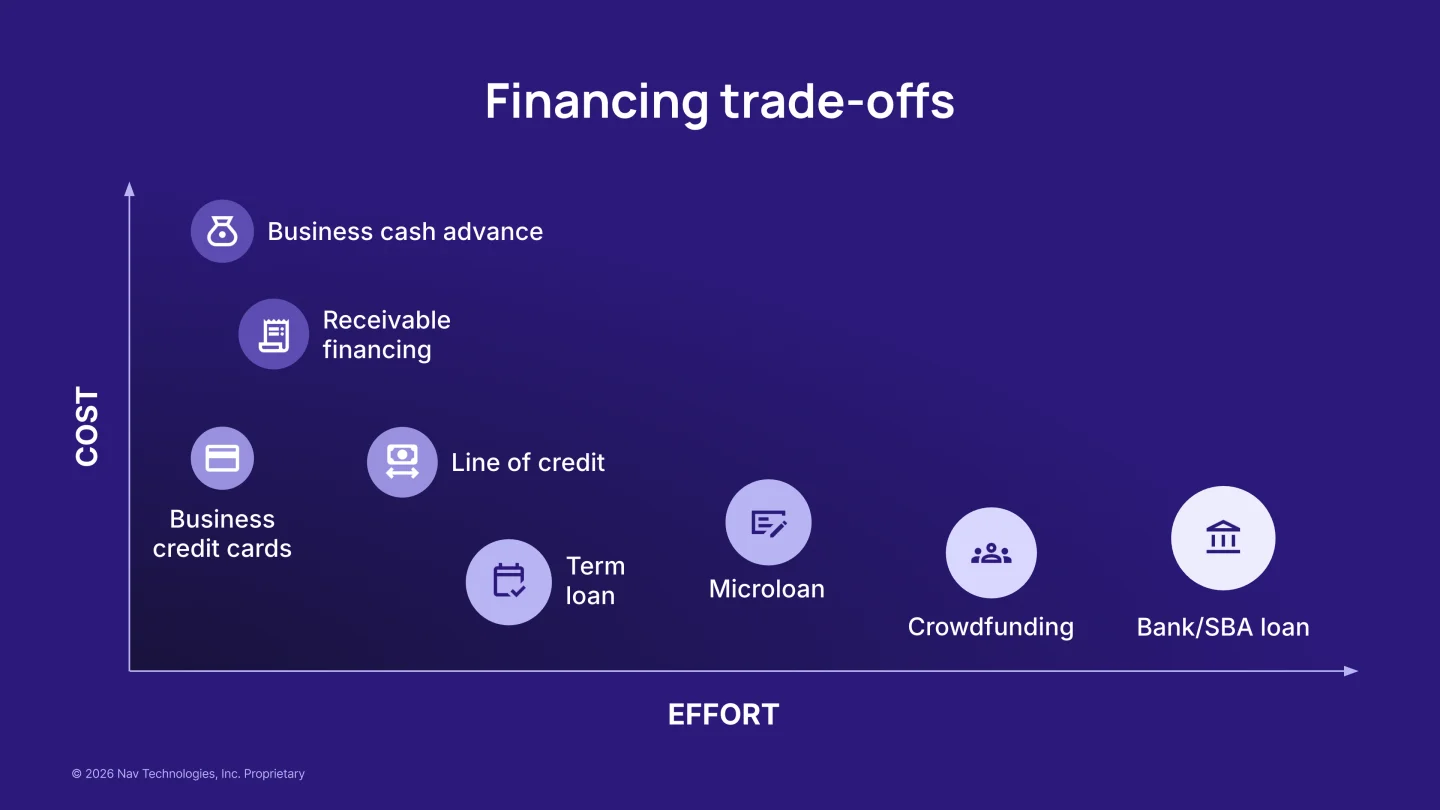
There’s one overriding principle that applies to most types of financing for businesses: the faster and easier it is to get financing, the more it will likely cost. There are a few exceptions, though, and we’ll cover those in this guide.
Goal | Best-fit loan types | Typical qualifications |
Working capital (money for operations) | Business line of credit, | Good personal credit often required |
Inventory | Line of credit, Inventory financing, 0% intro APR credit card | Good credit often required, personal guarantee common |
Equipment | Equipment loan or leasing, SBA 7(a) or 504 | Collateral required; Credit scores may be flexible for non-SBA financing |
Expansion | Term loan; SBA 504 or 7(a) loan | Lower-cost options require more documentation and higher qualifications |
Refinance debt | SBA 7(a) where eligible | Not all debts qualify for refinancing |
Startup costs | 0% intro APR credit card; Microloan; SBA 7(a); Crowdfunding | Startups are harder to fund than existing businesses; strong credit or business plan may be required |
Real estate | Commercial real estate (CRE) loan; SBA 504 | Strength of real estate being acquired is often key |
Top picks from Nav’s trusted partners:
Fundbox: For fast funding
Fundbox offers fast approval and funding, with funds available as soon as the next business day. The minimum personal credit score requirement of 600 makes this option available to business owners with a wide range of credit scores, and Fundbox reports payments to all major business credit bureaus via the Small Business Financial Exchange (SBFE).
Smartbiz: For low rates
Smartbiz offers SBA 7(a) loans, which are known for their competitive rates and predictable payments. Borrowers can get preapproved and review loan terms and conditions before needing to provide the more extensive documentation often required with SBA loans. Smartbiz has a 4.5 out of 5 rating on Trustpilot, with over 16,300 reviews as of Sept. 28, 2026.
Giggle: For startups and low revenue
Giggle provides working capital financing up to $15,000 to independent contractors, those working in the gig economy, and small businesses across the US. Verify your bank account and you may be approved instantly.
Revenued: For bad credit
Revenued Flex Line is a revenue-based, alternative business financing product that gives eligible businesses access to flexible funding tied to the Revenued Business Card. Revenued analyzes past revenue to offer an advance against future revenue. The credit check is a soft inquiry.
Compare small business loan types
Small business loans and financing come in many types, each with strengths and drawbacks. The best choice for your business depends on why your business needs financing, how much you need, how quickly you need it, and your qualifications.
Loan types compared
Loan type | Best for | Typical range amount | Typical cost range |
SBA loan | Working capital, equipment, expansion, acquisitions and qualifying refinance. | Up to $5 million for most loans; eligible borrowers may combine up to $5 million in 7(a) and $5 million in 504 funding for a total of $10 million. | SBA rates are capped; see current SBA loan rates here |
Bank term loan | Established businesses seeking lower cost financing. | Nearly all banks surveyed by the FDIC make small business loans of at least $1 million and about half make loans up to $3 million. SBA 7(a) loans are available up to $5 million. | Bank term loans ranged from 4.75% to 10.4% in June 25, 2026 Kansas City Federal Reserve's Small Business Lending Survey |
Online term loan | Business looking for faster access to capital with more flexible qualification requirements than traditional lenders | $5,000–$10 million+ | Varies by lender and qualifications; many quote factor rates with effective APRs of 25%+ are not uncommon. |
Business lines of credit | Quick access to short-term loan as needed | $1,000–$250,000 common online lenders; $100,000 to $5 million for banks | Documented revenue typically required; banks often also require good to excellent personal credit scores |
Equipment financing | Buying business equipment | Up to $5 million for SBA loans; bank loans and direct financing may provide up to 110% of equipment value | Type and value of collateral is a key factor. Credit qualifications may be more flexible than other types of financing |
Invoice financing and factoring | Collecting faster on unpaid invoices | Commonly offers 80%–95% of invoice amount | Factoring fee of 1%–5% per month |
Merchant cash advances | Businesses with strong revenue who cannot qualify or wait for traditional funding | Advance of 70%–90% of last 3–6 months of average monthly revenue | Factor rates of 1.2– 1.6 common |
Microloans and CDFIs | Smaller loans for borrowers that may have trouble qualifying for traditional loans | SBA microloans are capped at $50,000 | Interest rates are usually lower than other types of fast financing, but more expensive than traditional bank loans |
Nav is not a lender or a credit bureau. Credit information is provided by third-party sources.
SBA loans
Most SBA loans (except Disaster loans) are made by approved lenders with an SBA guaranty. The SBA 7(a) program is the flagship program, and funding can be used for working capital, equipment, business acquisitions, and refinancing qualifying business debt.
The limit for 7(a) loans is $5 million, though eligible businesses may be able to combine 7(a) and 504 financing for as much as $10 million in total SBA-backed financing. Rates may be negotiated between the borrower and lender, up to SBA maximum loan rates.
Bank term loans
Traditional bank loans may offer attractive rates and terms for borrowers who qualify. Banks typically fund established businesses, using revenue, time in business, industry, and credit to evaluate applications. Some banks can make decisions quickly, but it’s generally best to plan for at least three to four weeks for underwriting.
Online term loans
Online term loans can appeal to business owners who value speed. Some online lenders can provide same-day approvals and make funds available within a day or two. The tradeoff may be cost. Online lenders may charge high rates, and they may be expressed as a factor rate rather than an annual percentage rate (APR).
Sixty percent of borrowers using online lenders in the 2025 Small Business Credit Survey reported that their actual borrowing costs were higher than expected.
Business line of credit
A business line of credit provides access to a credit limit that the business owner can borrow against when needed. This structure can work well for recurring or unpredictable short-term needs.
Funding speed can vary considerably by provider. Some lenders can approve applications in hours, while banks can take several weeks or longer.
Equipment financing
Equipment financing is designed to help a business purchase equipment, with the financed equipment serving as collateral.
Even with collateral, lenders will evaluate other factors such as revenue and credit, though qualifications may be lower than unsecured financing.
Invoice financing and factoring
Invoice financing and factoring allow businesses to use unpaid customer invoices to access capital. Typically, the factoring company will advance a percentage of the invoice amount, and will base approval on the credit of the company that owes the invoice. It’s not the cheapest type of financing but it can be helpful for borrowers with limited options.
Merchant cash advance
A merchant cash advance (MCA) analyzes credit and debit card sales and uses that information to provide an advance against future sales. Payments are then typically deducted on a daily or weekly basis.
Funding is often fast (as little as the same day). Costs are usually stated as a factor rate. A factor rate of 1.2 means the borrower must back 1.2 times the amount of the advance.
Microloans
Microloans are smaller loans usually made by nonprofit mission-driven lenders.
SBA microloans cap out at $50,000 though most loans are smaller. Rates are competitive, and they often come with straightforward repayment terms.
These loans are often available in specific geographic areas so they can be harder to find than loans that are heavily marketed.
Business credit cards
Many business credit cards offer a line of credit that can be useful for short-term financing. Some cards offer 0% intro APRs which may help finance purchases interest-free for up to a year or longer, depending on terms.
Business credit cards are one of the few types of financing available to startups. For many cards, approvals are based on the owner’s personal credit and income from all sources (not just the business).
How to qualify for a small business loan
When it comes to qualifying for small business loan or financing, lenders often look at some combination of the following factors:
Revenue
Lenders want to see that the business will be able to repay the loan from cash flow. They will often review how much money the business is making by looking at recent bank statements, and in some cases, tax returns. A year-to-date profit-and-loss statement may be required as well.
Credit
Lenders may review personal credit, business credit, or both. Some types of revenue-based financing (like MCAs or BCAs) may be very lenient when it comes to credit scores. And invoice financing may look at the client’s credit history, rather than the borrower’s.
Collateral
Some types of loans require collateral. With SBA loans, for example, lenders must take collateral if available. When collateral isn’t available, lenders may require personal guarantees.
Industry
Most lenders prefer to lend into certain industries, and will not lend into others. One lender may lend to restaurants, for example, while another won’t. They often use NAICs codes or SIC codes to identify industry, so make sure you use the correct one.
How much do small business loans cost?
You have probably heard that comparing the annual percentage rate (APR) is a helpful way to compare the cost of loans. But APR may not include all costs of the loan, and in the case of small business financing, not all types use an APR. Here are some of the costs you may encounter:
Try to compare the total amount you will repay, how often you must make payments, and how long you expect it to take to repay the financing.
Loan cost glossary
Cost | What it means | How to compare |
APR | An annualized measure designed to help compare borrowing costs across financing offers | Use it as the starting point to compare costs, while also evaluating other costs and the total cost to repay the financing |
Factor rate | A multiplier used with some financing products such as merchant cash advances, business cash advances, and other online loans | Compare the cost of a factor rate to the APR using a business loan calculator |
Origination fee | A fee charged when the financing is originated, sometimes expressed as a dollar amount and other times as a percentage of the amount of financing | Ask whether it will be deducted from proceeds (which means you’ll receive less funding up front) or added to the amount owed |
Draw fee | A fee that may apply when you draw money from a line of credit | Include expected draw fees when comparing the cost of using the line |
Late fee | A charge that may apply if a required payment is late | Understand late fees in case you can’t make a payment on time |
Prepayment penalty | A charge that may apply when financing is repaid earlier than scheduled. | Some prepayment penalties decline over time, or may be waived for certain borrowers |
Fixed fee | A set charge that may apply to certain transactions | Include fees when evaluating costs |
APR vs. factor rate
APR and factor rate are two very different ways to describe costs, and if you confuse the two you may not realize how much you’re paying.
APR expresses financing on an annualized basis. It included the interest rate along with certain other fees and costs. A factor rate instead represents a multiplier used to calculate the total that must be repaid over time.
If a loan doesn’t list an APR, you can use business loan calculators like those offered by Nav to estimate the effective APR. This makes it easier to compare costs and to get an idea of how much a loan costs.
Keep in mind that financing with a shorter repayment period often results in a higher APR. For example, if you use a credit card balance transfer with a 3% balance transfer fee, you’ll pay roughly 3% if it takes you a year to pay it back. But if you pay it back in three months, your APR will be higher due to the shorter repayment period.
Fees that change the real price
Fees can increase the cost of a business loan even when the stated rate looks competitive. Review your offer for:
- Origination or closing fees
- Servicing fees
- Draw fees
- Wire fees
- Extension fees
- UCC filing fees
- Late fees
- Prepayment fees
- Other fixed fees
How much can you borrow?
The amount you can borrow depends on the financing, lender requirements, and your qualifications.
For SBA 7(a) loans, the maximum loan amount is $5 million. Most SBA 504 loans carry a similar limit. Eligible borrowers may be able to combine a 7(a) and 504 financing for as much as $10 million in SBA-backed financing, though each of those two programs will still cap out at $5 million. (504 loans are generally used for real estate and equipment.)
SBA microloans are much smaller. The maximum amount is $50,000, with an average loan closer to $16,000.
For every other type of financing, lenders will set minimums and maximums.
If you need a large amount of financing, make sure the lender offers that much, and try to understand whether you meet the lender’s requirements for the amount you need.
Business owners often combine different types of financing to get the funds they need. For example, a business might use a combination of supplier terms (such as net-30 payment terms), a business line of credit and/or a credit card for shorter-term borrowing, and term loan to finance a bigger project.
How to choose the best small business loan
To choose the best small business loan, you’ll need to ask yourself a few key questions:
- How much funding do I need? The answer here shouldn’t be “as much as I can get.” You want a clear idea of how much you need. Asking for too little can be just as risky as asking for too much.
- What will I use it for? Financing to purchase equipment that you’ll use for ten years requires very different financing than purchasing inventory you plan to turn over in a couple of months.
- What are my qualifications? This is a key question. If you have bad credit, for example, SBA loans or bank loans may not be an option. If your business is brand new, you’ll have fewer options than a business that has been operating for a few years.
Short-term vs. long-term financing
The financing term should make sense for the business need you’re trying to meet. For example, financing short-lived inventory is different from financing an expansion or a major piece of equipment.
Shorter financing may be useful for needs that generate cash quickly, while longer-term financing may better match purchases or projects expected to benefit the business over several years.
Getting a bank loan
Bank loans often carry some of the best rates and terms but they typically require significant documentation and take longer. While some online lenders may require the last three to six months of business bank statements, for example, a bank may also require two to three years of business tax returns.
Each lender is different, of course, so check requirements with the lender.
Make sure your business bookkeeping is up to date so you can provide the information the bank needs to review your application.
Funding a startup
Financing a startup can be more difficult because the business does not yet have the operating history of an established company. Federal Reserve research found that startup firms have different financing experiences from older businesses and must rely more often on owner funding.
Because new businesses don’t have revenue, lenders may rely on good personal credit and personal guarantees. Some SBA loans are available to startups, and business credit cards may be an option. Learn more about startup business loans here.
Buying a business
It’s not always necessary to start a business from scratch. If you don’t have enough money to buy it outright, or if the seller won’t finance the sale, you’ll need a business acquisition loan. Some lenders will finance business acquisitions, and some SBA loans can be used to finance the purchases of businesses.
How to apply for a small business loan
The application process for each lender may be somewhat different but typically you’ll need to:
Share details about your business. You’ll often be asked about:
- The start date of your business. If you have formed an LLC or corporation, you can use the date you formed that entity. Otherwise, you may use the date you received your Employer Identification Number from the IRS or the date you got your business license. If you have none of that information, you should use the date you officially started your business. Try to be consistent on applications.
- Your business address and phone number. (Home based businesses may use a home address but you may want to consider getting an official address for your business as well as a separate business phone number).
- Your employer identification number (EIN) if you have one. If you are an unincorporated business (sole proprietorship) you may use your Social Security number or Taxpayer Identification Number (TIN) but you may want to request a free EIN from the IRS.
- Identification. You will likely need to supply a driver’s license or passport to verify your identity.
Agree to a credit check. Not all financing offers will involve a personal credit check but many will. A personal credit check may involve a “soft” credit check that doesn’t impact your personal credit scores, but if you’re concerned about this be sure to ask. Some lenders will also check business credit scores.
Verify business revenues. Some lenders will allow you to provide copies of recent bank statements (three to six months is typical) or business tax returns plus up-to-date financial statements. Increasingly though, lenders will ask you to link your business bank account so they can analyze your business revenues to determine if you meet their requirements.
Some types of financing may have other requirements. For example, for invoice factoring you may need to supply an accounts receivables (A/R) aging report that shows your outstanding invoices. For loans with collateral, such as equipment or real estate, you may need a collateral schedule or even an appraisal.
Once you have submitted the required documentation, the financing company or lender will make its decision. Online lenders can typically offer a preliminary decision very quickly. They will then request any additional documentation so they can underwrite the loan and make an offer.
Banks tend to take longer to approve loan applications, and more documentation may be required. Expect more back and forth, greater scrutiny, and a longer wait before you get a decision.
Once you are offered financing you’ll want to read the loan documents carefully to make sure you understand the terms of the financing, including daily or monthly payments, the cost of the financing and whether a personal guarantee is required. Some financing sources may require you to use some of the proceeds to refinance other debt.
Once you accept you can expect funds in your account within hours, or up to a couple of days depending on the lender.
Organizing your documents before you apply can help make the process faster and easier.
Advertising Disclosure: The credit card, financing, and service products that appear on this site are from credit card, financing, and service companies from which this site receives compensation when a customer clicks on a link, when an application is approved, or when an account is opened. This may influence how and where products appear. However, it does not affect our evaluations or recommendations. Nav strives to provide accurate, up-to-date information, but you should always review the full terms and conditions on the issuer’s website before applying.
Personal FICO® credit scores and other credit scores are used to represent the creditworthiness of a person and may be one indicator to the credit or financing type you are eligible for. Nav uses the Vantage 3.0 credit score to determine which credit offers are recommended which may differ from the credit score used by lenders and service providers. However, credit score alone does not guarantee or imply approval for any credit card, financing, or service offer.
Editorial Disclosure: Our top priority is to provide accurate, unbiased financial information for your business. Nav may receive compensation from partners, but this does not influence our editors’ opinions or recommendations. Our partners cannot pay for favorable reviews. All content is accurate to the best of our knowledge when posted. Any views expressed are the author’s alone and have not been reviewed, approved, or endorsed by the companies mentioned.