

How much is commercial auto insurance? Costs by vehicle, use, and driver

Written byGerri Detweiler

Reviewed by Robin Saks Frankel
Summary
- Commercial auto insurance averages $245 for one vehicle, though costs can vary significantly — from as little as $31 to over $1,300 a month, according to insurance broker Insureon.
- The type of vehicle, how you use it, who drives it, and where you operate it, generally move the price more than which insurer you pick.
- A personal auto insurance policy isn’t a cheaper substitute because it won’t likely cover business use.
How much does commercial auto insurance cost?
Commercial auto insurance for a small business averages $245 a month, or about $2,942 a year, according to insurance broker Insureon’s survey of its customers. Your price depends on factors that include the vehicle itself, how you use it and how often you drive, the driving record of the driver, where your business operates, and policy limits.
While Insureon’s data found that their customers paid an average of $245, there was a wide range in premiums: 40% of small businesses pay less than $200 a month, another 29% pay $200 to $400 a month, and almost a third (31%) pay over $400 a month.
Commercial truck insurance and specialized vehicles will typically cost more.
What do the published averages actually measure?
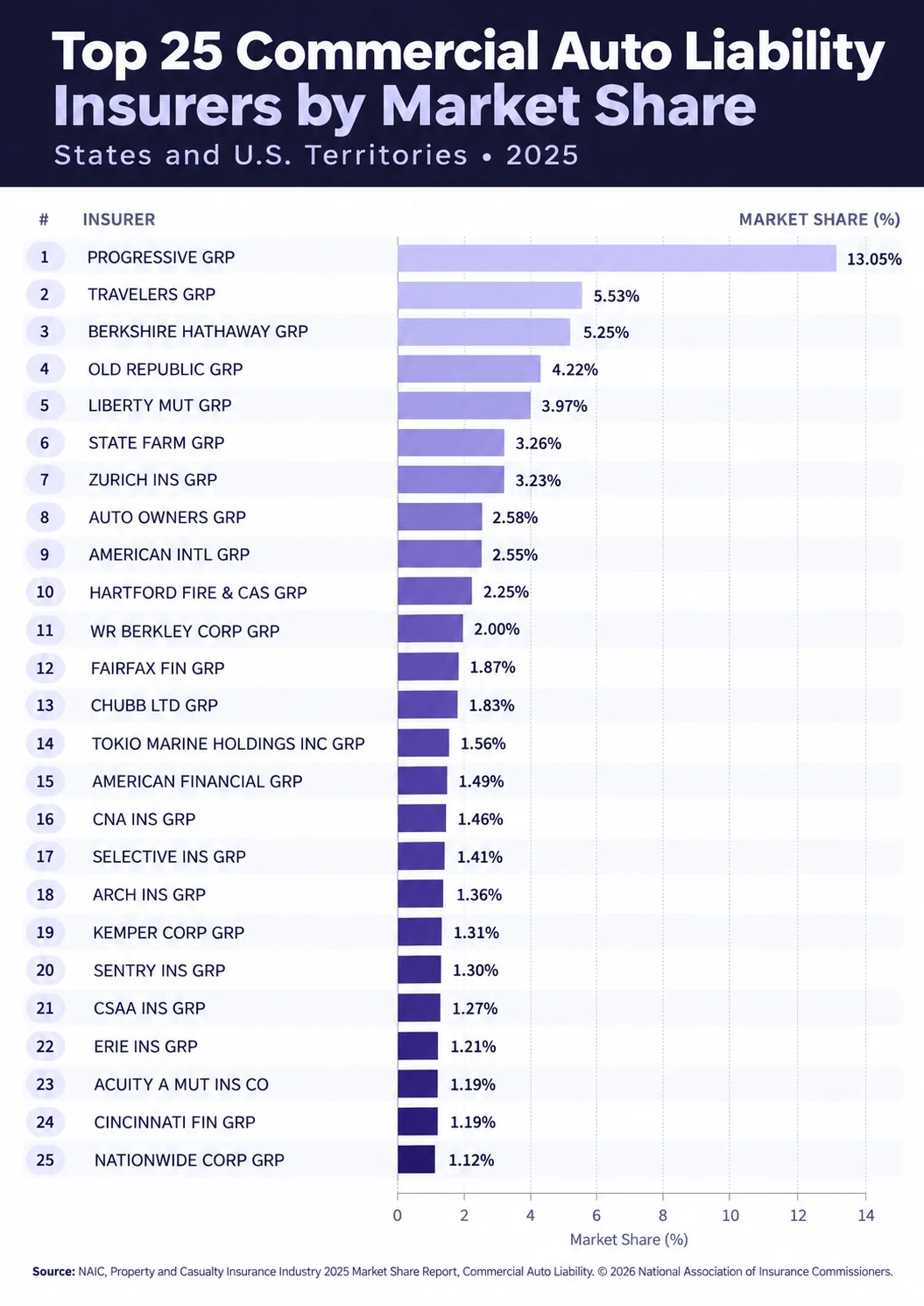
The average cost of commercial auto insurance varies by insurer. Each source below measures a different mix of vehicles, businesses, coverages and locations.
Source | Average cost | What it measures |
Insureon (marketplace) | $245/month | Average single-vehicle small business policy (2026) |
The Hartford (carrier) | $574/month | Harford customers (2026) |
Progressive (carrier) | $260/month for contractors | Progressive customers (2025) |
MoneyGeek (aggregator) | $421/month for commercial truck insurance | Aggregated rates |
Commercial auto insurance cost by vehicle type and use
To give you an idea of the range of costs for commercial auto insurance by vehicle types and use, we’ve taken costs available from public sources. Your individual cost will vary depending on all the factors we have discussed in this article.
Type of vehicle | Use | Cost | Source |
Cars, SUVs and vans | Restaurants, consultants, cleaning services | $245/month | |
Cars, SUVs and vans | Consultant, sales rep, occasional delivery | $100-$175/month | |
Pick up trucks, cargo vans, SUVs, trailers | Contractors, subcontractors, independent tradespeople | $260/month | Progressive.com |
Cargo van | Delivery, catering, mobile service | $200-$300/month | Businessinsurancecost.com |
For-hire truck | Truckers focused on transporting a single type of good (gravel or log haulers, for example) | $734—$926/month | Progressive.com |
Refrigerated truck | Food delivery, catering | $250-$400/month | Businessinsurancecost.com |
Tow truck | Towing business, auto shops, mechanics | $606/month | Progressive.com |
What moves the price up and down
Rating and underwriting are the two main ways insurers decide how much to charge, according to the National Association of Insurance Commissioners (NAIC). The main rating factors that affect premiums include:
- Coverages and deductibles
- Claims history
- Credit history (if used)
- Driving record
- Driver’s gender, age, marital history
- Location
- Miles driven
- Vehicle type
- Vehicle use
You may have more control over some of these factors than others. Your insurance broker or agent can help you understand the main factors impacting your rates.
What a commercial auto policy includes
While you may purchase commercial auto insurance to help pay for damages if your vehicle is in an accident, one of the main reasons you purchase insurance is to protect against damage to others.
Liability coverage is the main type of coverage you’re buying when you purchase commercial auto insurance. It pays for damages your business is obligated to pay for if your vehicle causes injuries or property damage, up to your limit.
Most states require at least some minimum of liability coverage, but state minimums may be fairly modest, requiring $15,000 to $50,000 per person for bodily injury. (See coverage requirements by state here.) Insurers will generally recommend at least $500,000 to $1 million in liability coverage.
Beyond liability, a policy can include:
- Collision, which covers damage from an accident or rollover
- Comprehensive, which basically covers losses liability doesn’t cover (except normal wear or tear or breakdown)
- Uninsured or underinsured motorist coverage and medical payments coverage, which most states require in some form
If you or your employees drive personal cars or rentals for work, hired and non-owned auto coverage may fill the gap. It sits on top of your own personal coverage. Depending on how you use your vehicle, and your insurance company’s policies, you may add it as an endorsement to a general liability or commercial auto policy.
Why does commercial auto insurance cost more than personal auto?
Commercial policies typically carry higher liability limits and cover business risks like employees driving, hauling tools or equipment, or making deliveries. Industries where drivers operate heavier vehicles or spend more time on the road will also likely pay more than the average driver. Because businesses face more liability exposure than individual drivers, the same vehicle will often cost more with a commercial policy.
How much more is commercial auto insurance? Again, it’s going to vary by a lot of factors, but as an example, Insureon reports the average commercial policy is $412 a month in Florida versus $326 for personal coverage.
What you don’t want to do is to hope that your personal policy will cover you when you drive your vehicle for business. Your insurer likely will not cover you if your vehicle causes damage or injury while you are driving for business. See Nav’s full comparison of personal vs. business insurance.
How to pay less for commercial auto insurance
There are a few levers you may be able to control if you are trying to lower your commercial auto insurance:
- Raise your deductible if your cash flow can handle a bigger bill after a claim
- Skip physical damage coverage on older or lower-value vehicles
- Hire drivers with good driving records
- Ask whether you can save money by bundling commercial auto coverage with other insurance
- As about telematics programs that monitor vehicle use and driving habits for potential discounts
- Pay your premium in full if possible to avoid installment billing fees
- Compare quotes from more than one insurance company
The bottom line
Commercial auto insurance is priced per vehicle based on how you use it and who drives it, and other risk factors. Published averages vary because they measure different mixes of vehicles and businesses. The cheapest policy isn’t necessarily the right one if it doesn’t cover your business needs. Understand how to plan for business insurance costs in Nav’s business insurance cost guide.
Business credit reports may be checked when you apply for insurance. Make sure you understand your business credit reports and scores. Nav is not a lender or a credit bureau. Credit information is provided by third-party sources.