

What is workers’ comp insurance for small businesses and how does it work?

Written byGerri Detweiler

Reviewed by Robin Saks Frankel

Summary
- Workers’ compensation insurance (workers’ comp) pays medical bill costs and lost wages when an employee is hurt or made ill on the job, and in exchange, it generally protects you from lawsuits over on-the-job injuries.
- Nearly every state requires it if you have employees. Texas and South Dakota have no general requirement, and Wyoming requires it only in extra-hazardous industries.
- Premiums are based on payroll and job classification, so a desk-based team pays a fraction of what a roofing crew pays.
- The fastest ways to lower your cost are accurate classification of workers, safety and return-to-work practices, and comparing costs with more than one carrier.
What is workers’ comp insurance?
Workers’ compensation insurance is coverage employers carry that pays for an injured or ill employee’s medical treatment, part of their lost wages, disability benefits, and rehabilitation when the job causes the illness or injury. In exchange, the no-fault system generally bars employees from suing their employer over the injury.
A standard policy has two parts. Part one covers your legal obligations under your state’s workers’ comp law. Part two, employers liability, covers liability from employee injuries that fall outside that law.
Each state runs its own system, so the rules differ from state to state. Premiums are set using classification rates, which most states adopt from the National Council on Compensation Insurance (NCCI) or a state rating bureau.
Four states — North Dakota, Ohio, Washington, and Wyoming — are monopolistic, as are U.S. territories Puerto Rico and the U.S. Virgin Islands. This means you buy coverage from the state fund instead of through a private insurer. Ohio and Washington also allow eligible companies to self insure. In Wyoming, state-fund coverage is required only in extra-hazardous industries.
Do you need workers’ comp insurance for your small business?
In most states, yes, you need workers’ comp when you hire your first employee. A handful of states set the threshold higher, at three to five employees. For example:
- Georgia requires coverage with three employees.
- Florida requires coverage for most non-construction businesses when the business has four employees.
- Tennessee makes coverage mandatory with five employees in a non-construction business.
On the other hand, Texas leaves workers’ comp optional for most private employers, and South Dakota has no law requiring it.
Stricter rules for some industries. Construction businesses in Florida and Tennessee need coverage with just one employee.
What happens without required coverage? Each state sets its own penalties and repercussions for failure to comply with requirements.
Georgia can assess a civil penalty of $500 to $5,000 per occurrence
California can issue a stop order that bars you from using employee labor until you’re covered. It also treats failing to insure as a misdemeanor that can result in a fine of not less than $10,000, imprisonment for up to a year, or both.
Regardless of state regulations, an uninsured employer can also be sued by an injured worker, and you may be legally liable for injury costs even when insurance isn’t required.
Do you need workers’ comp if you are self-employed or a sole proprietor?
You usually don’t need workers’ compensation if you are self-employed or a sole proprietor with no employees.
Owners may want to carry it anyway. Clients and general contractors may ask for proof of coverage before signing a contract, and regular health insurance is unlikely to cover an injury that happens on the job. If you’re wondering whether you need workers’ comp insurance for yourself as an owner, the answer depends on your state and business structure.
- Wisconsin policies exclude sole proprietors, partners, and LLC members unless endorsed to include them
- Ohio lets owners elect coverage, and an owner who doesn’t isn’t covered by the state fund if injured on the job.
- Georgia treats sole proprietors and partners as employers, not employees, but counts corporate officers toward its threshold.
- Florida counts officers and LLC members toward its four-employee threshold; however, a contractor or sub-contractor who is engaged in the construction industry and is a corporate officer or a member of a limited liability company can apply for and obtain a valid construction industry exemption.
Does a single-member LLC need workers’ comp?
A single-member LLC doesn’t need workers’ comp in most states. Wisconsin, for example, doesn’t require coverage for an LLC with members only and no employees. The moment your LLC hires, most states require a policy. In general, headcount, not entity type, triggers this requirement. A few states count LLC members toward their thresholds, so check yours.
For more on coverage with your business structure, see Nav’s guide to LLC insurance.
What about 1099 contractors?
Genuine independent contractors generally aren’t covered by your policy and don’t count toward your employee total. But calling an employee a contractor doesn’t make them one. The U.S. Department of Labor calls misclassifying employees as independent contractors a serious problem. Because workers’ comp is set by state law, check your state’s test instead of only relying on a federal one.
In some states, you can also be responsible for an uninsured subcontractor’s workers. In Florida, if a subcontractor doesn’t have coverage, its workers become the contractor’s employees. Insurers ask about subcontractors during audits, too.
Business owners often collect a certificate of insurance from every subcontractor before work begins. Florida requires contractors to confirm subcontractor coverage before work starts.
Workers’ comp vs. general liability insurance
General liability covers injuries and property damage to third parties, such as customers, visitors, and vendors. Workers’ comp covers your own employees. Neither replaces the other, and businesses with employees may want to carry both.
Workers comp | General liability | |
Who is covered | Your employees, for work-related injuries and illnesses | People who aren’t your employees, such as customers and visitors |
What triggers a claim | An employee is hurt or made ill because of the job, regardless of fault | A third party is injured, or their property is damaged, because of your business |
Legally required | Required in nearly every state once you have employees | Usually not required by law, though clients often ask for it |
How it’s priced | Payroll and job classification, adjusted by your claims history | Varies by business type and other factors |
For pricing details, see general liability insurance cost.
How much does workers’ comp insurance cost?
For a typical full-time employee, workers’ comp costs employers about $75 a month. That’s based on an average of 43 cents per hour worked and a 2,080-hour work year (BLS data). The average covers every industry, so office jobs cost much less and high-hazard trades cost far more. Among Insureon’s small business customers, the average policy runs $54 a month, and nearly half (47%) pay less than $50.
Premiums are based on payroll and job risk, not headcount or revenue. Nationally, employers paid about 98 cents per $100 of covered payroll in 2023. A 2024 comparison of all 51 U.S. jurisdictions put the median at $1.09 per $100, though those state figures are index rates for comparing states, and not what any one employer pays. By job type, the spread is wide. Clerical office work can cost 4 cents to 48 cents per $100, while roofing can run from roughly $1 to over $28 per $100, depending on the state.
Here’s the basic formula: your classification rate x (payroll divided by 100) x your experience modification factor, then adjusted for any credits, discounts, or state assessments. For example, using illustrative numbers, $100,000 in payroll at a $2.00 rate comes to $2,000 before adjustments, and a 0.90 mod brings it to $1,800.
Typical rate ranges by job type
Job type | Rate per $100 of payroll |
Clerical and office | 4–48 cents |
Retail | 55 cents–$3.05 |
Restaurants | 48 cents–$3.11 |
Light construction (carpentry) | $1.95–$17.93 |
Roofing | $1.18–$28.84 |
Calculated manual rates as of January 1, 2024, across 50 states and Washington, D.C. These aren’t the rates any one business pays. Your state, carrier, and experience mod can all change the final premium. Rates have also fallen since 2024: NCCI estimates rate and loss cost changes should cut premiums about 5% from 2025 to 2026 in the states where it provides ratemaking.
If you think in terms of headcount, remember that payroll and the type of work drives the premium. Using the 2024 rates above, the premium for a clerical employee earning $40,000 a year would cost about $16–$192 a year in premiums, or roughly $1–$16 a month. For a roofer earning the same amount, the premium could be about $472–$11,536 a year, or roughly $39–$961 a month.
Your premium starts as an estimate. When the policy ends, your insurer reviews your actual payroll, operations, and job classifications and adjusts the premium, which can mean a bill or a refund. Pay-as-you-go policies still get a final audit.
Your experience mod compares your claims history with similar businesses. A clean history earns a mod below 1.00 and a lower premium, while a worse-than-average history means a mod above 1.00.
How to get cheaper workers’ comp insurance
- Classify every employee correctly. Clerical staff can be classified separately from field workers at a much lower rate, so putting everyone in one high-risk class can mean overpaying.
- Ask about pay-as-you-go. These policies are billed from actual payroll each pay period instead of an annual estimate, and some run through your payroll service. You’ll still get a final audit, which could mean a final bill or refund.
- Build a safety program and a return-to-work program. Employers that invest in workplace safety may pay lower workers’ comp costs.
- Shop around. Compare quotes from more than one carrier. In most states, you can also compare private carriers with the state fund, and roughly 20 states have a competitive state fund. A PEO (professional employer organization) or payroll-bundled policy is another route.
- Ask about deductible plans. Oregon and many other states let employers buy large-deductible policies or pay part of some medical costs to improve their experience ratings. Availability varies by state.
A return-to-work program is designed to keep injured, disabled, or temporarily impaired workers employed as possible. Stay-at-home and return-to-work programs can also lower employer costs, and NCCI’s experience rating plan rewards employers for helping injured employees return to work as soon as reasonably possible.
New York offers premium credits for safety, drug-free workplace, and return-to-work programs. AskEARN, an employer resource service, estimates savings of $8 to $10 for every $1 invested in return-to-work programs, but treats that as an estimate, not a guarantee.
How to buy workers’ comp insurance for a small business
- Confirm your state’s requirements. Check whether your state requires coverage for your headcount and industry, and whether it’s monopolistic. In North Dakota, Ohio, Washington, and Wyoming, you buy from the state fund.
- List your employees by role, with annual payroll for each. Quotes start from estimated payroll, and your final premium is based on actual payroll by classification.
- Identify the class codes that fit each role. Every role gets a classification, and clerical roles are usually separate from field roles.
- Gather your business details. Have your EIN, entity type, years in business, and prior coverage and claims ready. Your claims history feeds your experience mod.
- Compare quotes. You can use a marketplace, an independent agent, or a payroll provider. Compare carriers side by side with Nav’s insurance marketplace.
- Buy, then post the required notice. Many states require you to display proof of coverage, so post a notice of coverage.
- Set up your injury reporting process. Late reports can be penalized. New York can penalize up to $2,500 for a late first report. Minnesota doesn’t let insured employers pay medical bills directly, and NCCI’s rules reduce the incentive to skip reporting medical-only claims. Report injuries promptly, even small ones.
For the bigger picture on buying insurance, read top insurance mistakes business owners make.
Workers’ comp options for small businesses
Here are the top 25 workers’ comp insurance providers by market share, according to the NAIC 2025 Market Share Reports.
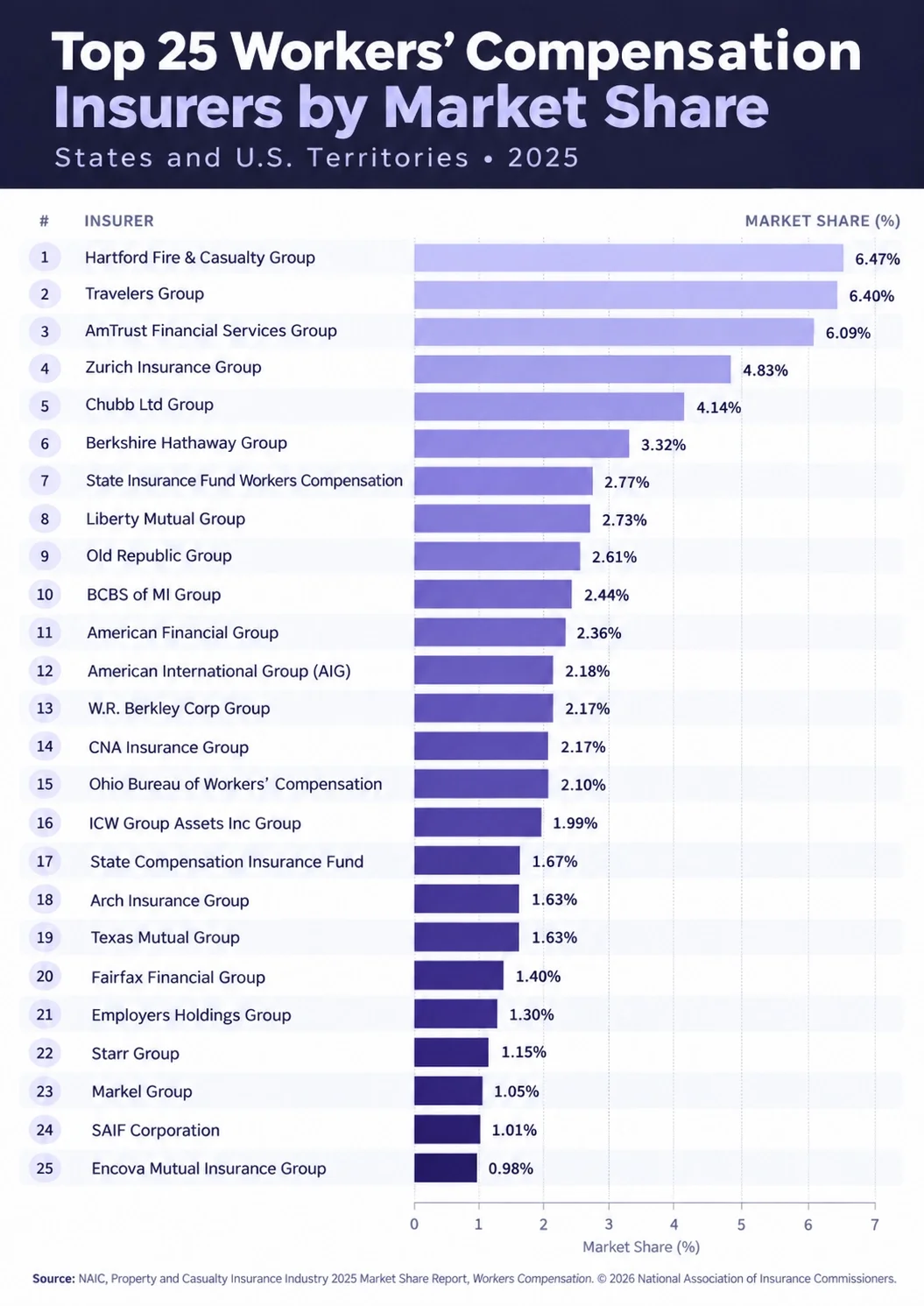
You can buy workers’ comp through several channels, and the best fit depends on your state, size of business, and cash flow. There are specialists that may work with small businesses like yours.
Private insurers provided more than half (55.6%) of workers’ comp benefits in 2023, according to the 28th annual workers’ compensation report produced by the National Academy of Social Insurance.
Channel | How it works | Often a fit for |
National carriers | Large insurers that sell workers’ comp, often through independent agents and brokers | Businesses that also buy other commercial coverage from the same insurer |
Workers’ comp specialists | Insurers that focus on workers’ comp | Businesses that want a carrier focused on this coverage |
State fund | State-run insurers. Required in ND, OH, WA, and in WY for extra-hazardous industries; while competing with private insurers in roughly 20 other states | Employers in monopolistic states, or businesses that want another quote |
Payroll integrated pay-as-you-go providers | Premium is calculated and paid each payroll cycle from actual payroll data | Businesses with changing headcount, or that value the convenience of running payroll and workers’ comp through the same system |
PEOs | Co-employment: the PEO secures workers’ comp for your employees under its own policy | Businesses that also want payroll and HR services bundled |
Marketplaces | One application collects quotes from several carriers | Businesses that want to compare before choosing |
Nav’s business insurance marketplace lets you compare options in one place.
Workers’ comp mistakes small businesses make
Treating employees as contractors to avoid coverage. Misclassification is a serious problem, and in Florida an uninsured subcontractor’s worker can become your employee.
Using one class code for everyone. Clerical work has a much lower rate than field work, so lumping staff together can mean overpaying.
Understating payroll at purchase. Your final audit uses actual payroll, and the difference can come back as a bill.
Skipping or stalling the annual audit. A carrier may cancel your policy or raise your final audit premium, and you may lose your experience mod.
Letting coverage lapse in a slow season. Seasonal workers count, and going uninsured can bring penalties such as Minnesota’s fines of up to $1,000 per employee per week. There’s also the risk of a lawsuit from an injured employee.
Reporting injuries late. New York can penalize up to $2,500 for a late first report.
Having no return-to-work plan. Return-to-work programs can lower employer costs, and NCCI’s plan rewards helping employees return to work.
The bottom line:
Nearly every state requires workers’ comp once you hire employees. It’s priced on payroll and risk, not revenue, so the cheapest policy is the one that is accurately classified. Clients often ask for proof of coverage before signing a contract. Failing to get workers’ comp when it’s required can be expensive.