
Refund regrets: An analysis of Americans’ post-tax filing spend

Robin Saks Frankel
Senior Content Editor

Summary
- Oklahoma City and Orlando, Fla. residents are the most likely to have tax refund regrets.
- Two in five Americans have regrets about how they have spent their tax refund.
- Paying down debt and adding to savings are the most common plans Americans have for their tax refunds this year.
- One in six small business owners plan to reinvest their tax refund into their business.
- More than two-fifths of small business owners have regretted how they've spent a past tax refund.
- Nearly two in five small business owners view their tax refund as a mix of both business and personal money.
Editorial note: Our top priority is to give you the best financial information for your business. Nav may receive compensation from our partners, but that doesn’t affect our editors’ opinions or recommendations. Our partners cannot pay for favorable reviews. All content is accurate to the best of our knowledge when posted.
Springtime for many means a thaw in the weather and may provide an opportunity for a boon to your bottom line. For those who are eligible for a tax refund, it’s an opportunity to get a jump on financial plans like paying down lingering debt or building an emergency fund. But once the check is deposited in your account, those fiscally responsible intentions don’t always hold.
At Nav, we work closely with small business owners who, like many Americans, find themselves wishing they could redo their refund spending. That’s why we set out to learn more about the refund regrets Americans and entrepreneurs are experiencing and what plans are being put into place ahead of this year’s tax season.
To do this, we surveyed Americans in 40 of the most populated cities and asked a variety of questions about past spending habits and upcoming plans for this year’s refund. Using these responses, we calculated a tax refund regrets score and ranked cities where residents have the most and least regret.
In addition to our national study, we also wanted to learn more about small business owners’ experiences with tax season. So we surveyed more than 500 small business owners across the U.S. and asked about their spending habits during tax refund season, their plans for this year, how comfortable they feel making tax-related decisions for their business, and more. Read on to learn more about our findings.
Where Americans regret their tax refund spending most
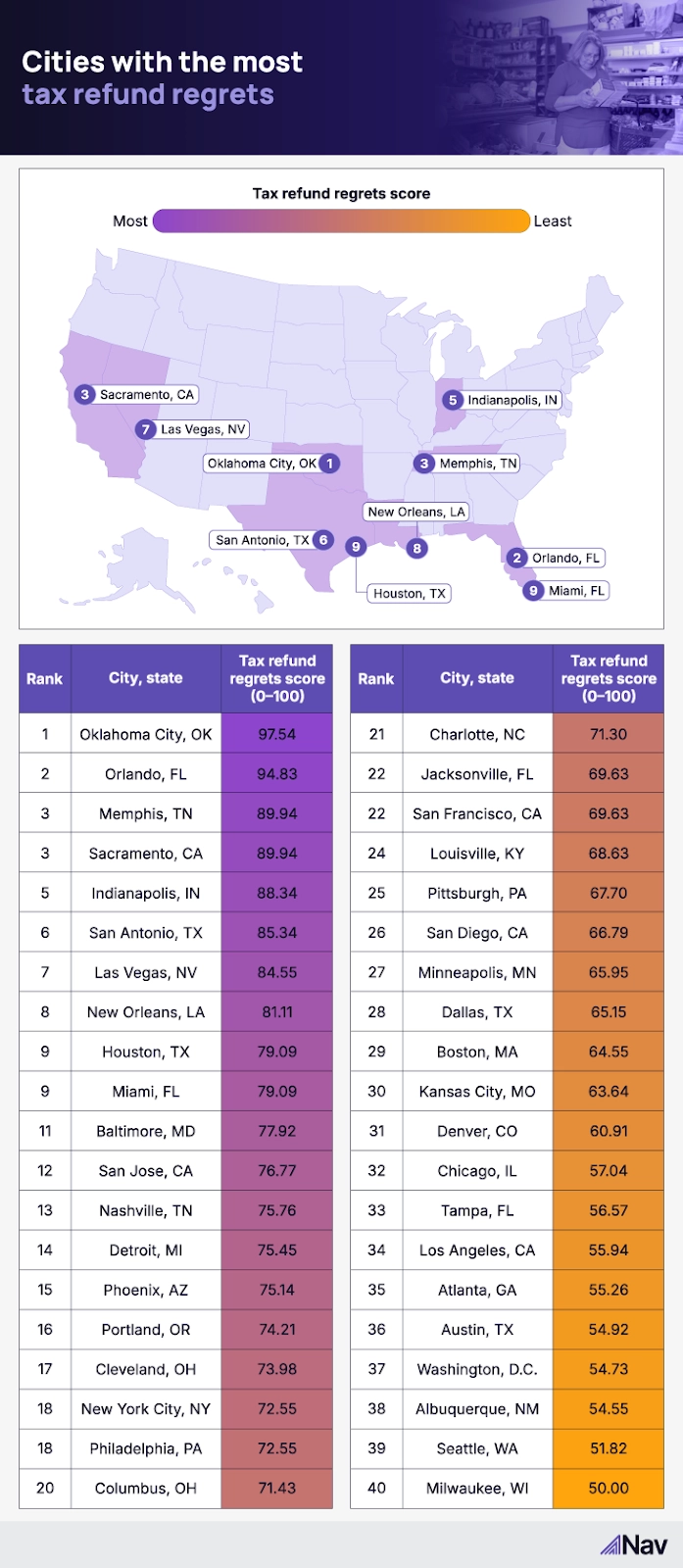
Overall, we found that two out of five Americans have regrets about how they spent a tax refund. When looking at levels of regret regionally, we found Oklahoma City leads the way with a tax refund regrets score of 97.54 out of 100. Even as the leaders of spending remorse, Oklahoma City residents are the most likely to say they plan to use their refund on a trip or vacation.
Orlando, Fla. is in second place with a score of 94.83 out of 100, with 47% of residents indicating they wish they spent a post-tax windfall differently When asked about the purchases they wish they hadn’t used their refund for, we found electronics and gadgets were the most common answers.
It’s a tie for regrets between Memphis, Tenn., and Sacramento, Calif, with both scoring 89.94 out of 100. While many regrets revolve around frivolous spending, we found Memphis residents are the most likely to rue being responsible with their refund, and wished they had treated themselves instead. But Sacramento tied with San Francisco, as the residents most likely to struggle sticking to their planned spending.
Rounding out the top five is Indianapolis, with a score of 88.34 out of 100. While 83% of residents say their spending matched their original plans, Indianapolis residents are the most likely to wish they had paid off more debt last year with their refund.
Not all Americans reach the end of tax season with empty wallets and contrite feelings. In fact, more than two-fifths of Americans consider themselves to be very disciplined regarding their tax refund spending.
Leading the way for the least regret is Milwaukee, as one in three residents say they plan to use their refund to pay down debt this year. Seattle follows next where 70% of residents say they have no regrets and are always happy with their spending choices. Finally, in third place for the least regret is Albuquerque, N. Mex. as 68% of residents say their spending did not stray from their original plans last year.
Most common purchase regrets and plans for this year’s refund
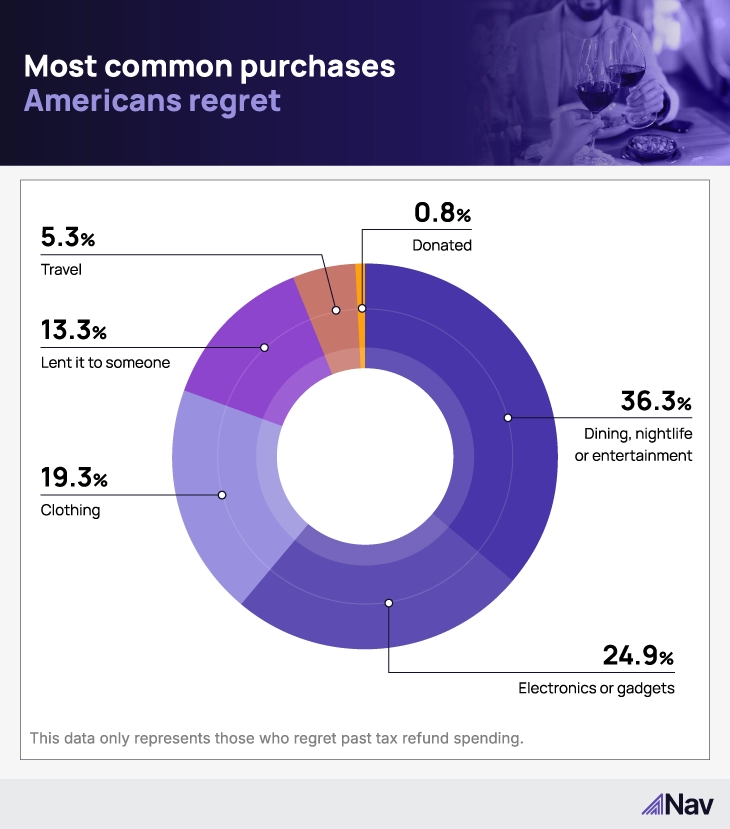
In addition to gaining insight on the most regret-filled areas of the country, we took a deeper dive into discovering what purchase types were causing Americans to have regrets. Leading the way as the most common area of remorse is spending on dining, nightlife and entertainment, according to more than one-third of our respondents.
Second place regret spending was on electronics and gadgets, with one in four people say these are the purchases they regret most. This is followed by clothing, which nearly one in five Americans wish they hadn’t bought with their refund. Next on the list of regretted uses of tax refunds are those who lent someone money (13.3%), followed by those who used their funds for traveling (5.3%), and those who donated (0.8%) claiming fifth and sixth place, respectively.
If given the opportunity to change past spending, more than two-fifths of Americans say they would save or invest more of their refund. The second most common change we found was paying off more debt, as indicated by 21% of respondents.
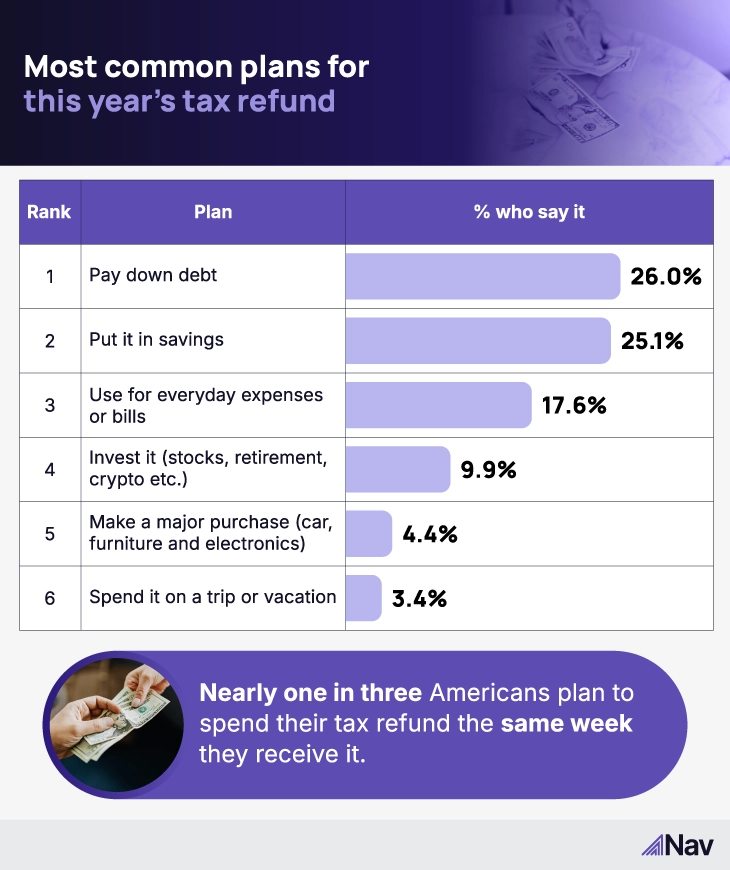
This year, many Americans are looking to make good on their spending plans. For one in four people, this means paying down debt, making it the most common plan for anticipated 2026 refunds. The next most common response was to put the extra money into savings (25%).
For nearly one in five people, money received through their tax refund will be reserved for everyday bills and expenses like rent and groceries. When asked about the urgency of this money, we found that nearly two-thirds of those surveyed say they would experience financial stress if their refund were delayed by six months.
While some people will be careful to hold onto their refund, nearly one in three Americans plan to spend the money the same week they receive it. For some this immediate spending is necessary, but we discovered that nearly one in four people have regretted how fast they have spent a refund check.
A look inside small business owners’ tax refund plans
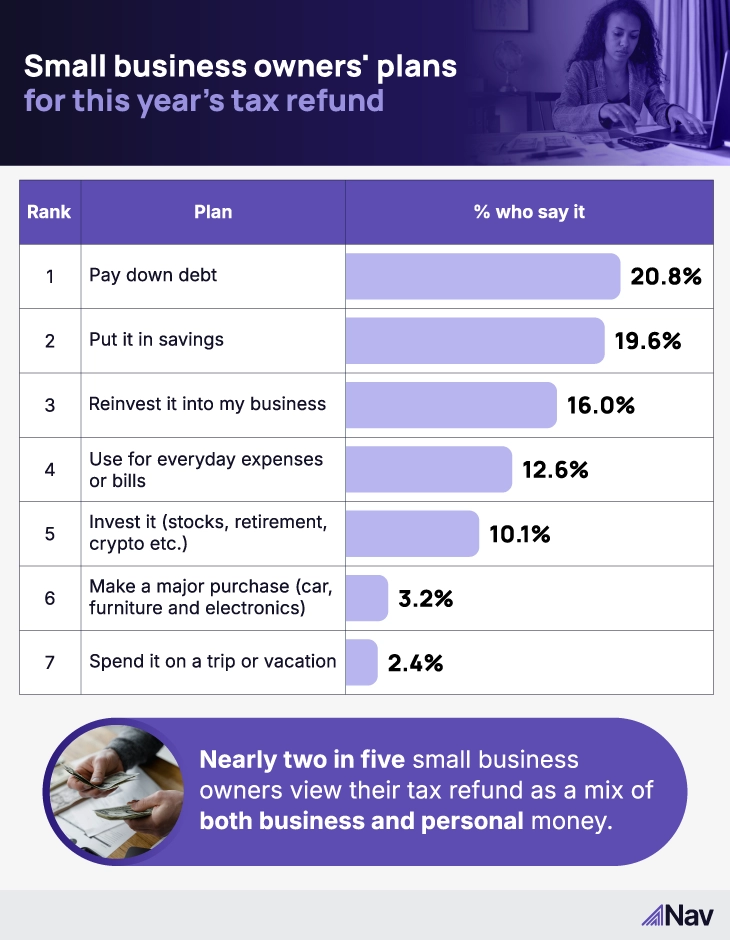
Many entrepreneurs in the U.S. rely on receiving a tax refund. Overall, we discovered that nearly two in five small business owners view their tax refund as a mix of both business and personal money.
While the filing process may look different for those running their own business, the feeling of remorseful spending is similar as more than two-fifths of owners have regretted how they've spent a past tax refund.
When looking ahead to this year’s funds, we found that paying down debt is once again the most common plan for one in five small business owners. For 20% of respondents in this category, the plan is to put the extra money into savings, followed by 16% who have plans to reinvest back into their business. This is up from the 10% who say they reinvested last year’s refund.
Overall, 42% of small business owners say they feel disciplined with their tax refund spending. This is shown through the 73% of entrepreneurs who say their spending last year matched their original plan.
Make informed financial decisions for your business with Nav
According to an analysis by Piper Sandler, based on Joint Committee on Taxation (JCT) data, total federal tax refunds in 2026 could be approximately $91 billion higher than in 2025, subject to economic conditions and filing behavior. What happens next depends on behavior. While some Americans might forgo responsible planning for leisurely spending with minimal repercussions the stakes can be higher for entrepreneurs.
At Nav, we work closely with small business owners to help improve their financial health with a range of tools, from ones designed to help track business and personal credit side-by-side to those that help you find the right funding option that best fits your needs. Whether you are just starting your business or are looking to grow your operations, the team at Nav is here to help. Get started today!
Methodology
In this study, we set out to learn about small business owners' plans for this year's tax refund. To do this, we surveyed more than 500 entrepreneurs across the U.S. and asked a variety of questions about their plans for this year's refund, as well as how they have spent past refunds, areas of regret regarding past refunds, if they have reinvested their refund back into their business and more.
We then awarded points to answers that represented regret and calculated an average regret score by owner. To create a ranking, we then calculated the average score based on years in business and adjusted those scores on a scale of 0 to 100, with 100 representing the most remorse. The regret score is a Nav-created index based solely on survey responses and does not represent an objective financial assessment.
In addition to our small business owner research, we also wanted to gain insight into Americans' refund regrets as a whole. So we surveyed residents in 40 of the most populated cities and asked them questions about their plans and regrets. We then calculated the same regret score, while averaging scores by city to create a ranking of where residents experience the most tax refund regret.
Rate this article
This article currently has 1 rating with an average of 5 stars.
Robin Saks Frankel
Senior Content Editor
Robin has worked as a personal finance writer, editor, and spokesperson for over a decade. Her work has appeared in national publications including Forbes Advisor, USA TODAY, NerdWallet, Bankrate, the Associated Press, and more. She has appeared on or contributed to The New York Times, Fox News, CBS Radio, ABC Radio, NPR, International Business Times and NBC, ABC, and CBS TV affiliates nationwide.
Robin holds an M.S. in Business and Economic Journalism from Boston University and dual B.A. degrees in Economics and International Relations from Boston University. In addition, she is an accredited CEPF® and holds an ACES certificate in Editing from the Poynter Institute.