

How tariffs can impact your small business: An up-to-date guide


Written byRobin Saks Frankel & Gerri Detweiler

Summary
- Tariffs can increase the cost of imported goods, leading to higher expenses for small businesses that rely on foreign products or materials.
- To maintain profit margins, you might need to raise prices, which could affect customer demand and competitiveness. Plus, tariffs can disrupt supply chains, causing delays and requiring you to find alternative suppliers, which may not be cost-effective.
- Staying informed about tariff changes and consider diversifying your supply sources so you can look for ways to address potential negative impacts on your business.
If you're a small business owner, you may be wondering how current tariffs will affect your business. Keep an eye out here for periodic updates on the state of tariffs in the United States.
July 24, 2026
Tariffs again, but different reasoning
The Trump administration is having another go at imposing tariffs on U.S. imports, this time with a new set of duties that went into effect at 12:01 July 24, 2026, the same time the temporary tariffs expired. The new levies of 10% and 12.5% were announced in a Federal Register notice on July 23, and allege that more than 60 trading partners representing over 80 countries are using forced labor to produce many goods being imported. The tariffs cover the top 60 U.S. trade partners and represent 99.4% of U.S. imports but have several exemptions, including oil and gas, fertilizer and certain raw and agricultural products.
An administration official told reporters that the new duties were the "most sweeping international labor rights action the United States has ever taken." Critics of the new rules say that higher prices on imported goods is likely to lead to higher prices for consumers and do little to tamp down inflation. Small business owners who rely on imported goods may continue to be affected similarly to how the initial round of tariffs had an impact.
A complete list of exemptions by country can be found in Annexes 1 and 2 of the Federal Register notice.
May 23, 2026
Still seeking refund clarity
May brought another major round of legal and regulatory changes affecting small businesses. Earlier in the month, a federal trade court struck down the administration’s newer 10% global tariffs that had been imposed under Section 122 after the Supreme Court previously ruled against many earlier IEEPA tariffs in February. The court said the administration exceeded its authority under the 1974 trade law because the U.S. trade deficit did not meet the legal threshold required for those emergency tariffs.
Despite the rulings, tariff policy has not stabilized. The administration has indicated that it may continue pursuing additional trade actions using other legal authorities, including Sections 232 and 301. Additional investigations and proposed tariffs involving pharmaceuticals, technology products, automotive parts, and industrial materials remain under consideration.
For small businesses, the biggest issue remains uncertainty. Many import-reliant businesses continue facing elevated costs, while also trying to determine whether they may qualify for refunds tied to overturned tariffs. Businesses that rely on imported inventory, packaging, equipment or raw materials continue facing challenges around pricing, supplier negotiations, and cash flow planning as trade rules evolve month to month.
April 14, 2026
New tariffs and unclear refunds
President Donald J. Trump’s big plans for tariffs, announced last year and codified in an executive order one year ago, have had mixed results. In February, the Supreme Court ruled that the president’s use of the International Emergency Economic Powers Act (IEEPA) to impose these tariffs exceeded presidential authority in a 6 to 3 vote, and effectively put a halt to the taxes that impacted many U.S. businesses that rely on imports.
Although the tariffs initially fueled a significant increase in federal revenue – small businesses in particular felt the pinch of higher prices for imported supplies and other items necessary for their operations. According to the U.S. Chamber of Commerce, approximately 97% of importers in the United States are small businesses, many of whom have been deeply affected by the increased cost of doing business since the tariffs were imposed.
In spite of the Supreme Court stating that the IEEPA did not give the president the authority to impose taxes, and that the tariffs may be eligible for refunds, the path forward remains murky. In addition, although the IEEPA tariffs were invalidated, on April 2, the president set forth two new sets of tariffs: The first one is a restructure and reduction of the levies on steel, aluminium and copper and the second is an increase on patented pharmaceutical imports.
February 23, 2026
SCOTUS says no; President finds a new way to say yes
To tariff or not to tariff? The answer to that question has whipsawed in the last few days. The Supreme Court on Feb. 20, 202 voted 6-3 to effectively end the widespread tariffs President Trump imposed, determining that the President’s invocation of a rarely-used statute, the International Emergency Economic Powers Act (IEEPA), was a violation of federal law. But halting the tariffs brought up an as-yet-to-be solved issue as to if the tariffs charged so far should be returned.
The President took umbrage at the court’s decision, and later that afternoon, signed an executive order to impose tariffs of up to 10%, stating that he was allowed to do so under Section 122 of the Trade Act of 1974. The next day he raised the rate from 10% to 15%. Section 122, which has never been previously used to effect tariffs, allows the president to impose tariffs for up to 150 days to address trade deficits. After 150 days, Congressional approval would be required to extend the ruling.
The push-pull between POTUS and Congress is still developing and it’s unclear how, if at all, the of-the-moment 15% tariffs imposed might change. As it stands, the tariffs would continue to have a sweeping impact on businesses, particularly those who rely on components from international trade.
December 12, 2025 update
Waiting for the Supreme Court
Manufacturers are scaling back activity in anticipation of the Supreme Court’s ruling to allow President Trump to enforce tariffs under the International Emergency Economic Powers Act (IEEPA). If it’s determined that the President has the authority to enact all of his proposed tariffs, the move is expected to reduce retailers’ profit margins and put strain on supply chains during the typically-lucrative holiday shopping season.
The Supreme Court is expected to announce its ruling this week, which will impact small businesses across the U.S., particularly those who are already feeling the pinch of inflation. That, plus the potential for higher prices for needed overseas items, have led to a big decline in small business owners’ confidence in Q4, according to the most recent MetLife & U.S. Chamber of Commerce Small Business Index report.
Sources: The Wall Street Journal, December 10, 2025, Axios, December 10, 2025, The MetLife & U.S. Chamber of Commerce Small Business 2025 Q4 Index
November 21, 2025 update
Many SMBs absorb tariff costs
In a recent survey of small business owners, Bredin reports that tariff and inflation are driving up costs and resulting in price hikes. Very small businesses (“VSBs” of 1–19 employees) and medium businesses (“MBs” of 100–500 employees) are most likely to have experienced supply price increases, while small businesses (“SBs” of 20–99 employees) are most likely to have raised prices. It also reports that small businesses "of all sizes are also likely to have taken a margin hit by absorbing some cost increases."
Source: Bredin State of SMB: The Effect of Inflation and Tariffs (email; November 20, 2025)
SCOTUS to decide on legality of certain tariffs
In early November, the Supreme Court heard oral arguments in two consolidated cases challenging President Trump’s authority to impose tariffs under the U.S. International Economic Powers Act (IEEPA). The Court is expected to make a decision in 2026, but it could come earlier. Legal outcomes are uncertain, but if the tariffs in question are held to be illegal, the Court will have to grapple with remedies, including refunds.
Source: Fastmarkets interview with Wilbur L. Ross, November 20, 2025
Reciprocal tariffs rolled back
Recent tariff activity has focused mainly on implementation of previously announced tariffs, and rollbacks or adjustment to others. With a November 14, 2025 executive order, for example, President Trump eliminated reciprocal tariffs on over 200 agricultural items including bananas and other fruit; beef; coffee and tea; and certain fertilizers.
Source: Denton’s, a global legal firm, November 19, 2025
Tariff trackers
Want to keep track of tariff changes? It’s challenging, but a number of online “tariff trackers” make it possible to follow major updates in tariff and trade policy*. Among them:
- Reed Smith, an international law firm
- Atlantic Council, a nonpartisan organization focused on international affairs
- WTO-IMF Tariff & Trade Data, from the World Trade Organization and International Monetary Fund
- Urban-Brookings Tax Policy Center, which is focused on “how tariffs will affect federal revenues, households, and the economy”
September 29, 2025 update
President Trump announced a new round of U.S. tariffs, set to take effect on October 1, 2025, in a post on Truth Social. The proposed tariffs target several categories of imported goods, including:
- Heavy trucks: 25%
- Kitchen cabinets and bathroom vanities: 50% (update: now scheduled to take effect January 1, 2026)
- Upholstered furniture: 30%
- Brand-name & patented pharmaceuticals: 100% — though companies that have "broken ground" or are "under construction" on new U.S. manufacturing plants may be eligible for exemptions (update: threatened but not implemented)
International trade considerations
A previously negotiated agreement with the European Union and Japan reportedly caps tariffs at 15% for certain categories. It remains unclear whether the new tariffs will override those caps, or whether those imports will continue to be protected.
Legal and regulatory developments
In announcing the tariffs, President Trump cited "national security" as the legal basis, a move widely seen as an effort to shield the policy from judicial review. This strategy mirrors previous attempts to justify tariffs under the International Emergency Economic Powers Act (IEEPA) — an approach that has faced increasing scrutiny.
The U.S. Supreme Court has agreed to hear challenges to the use of IEEPA for imposing tariffs on an expedited basis, with oral arguments scheduled for November 5, 2025. Outcomes from this case could have significant implications for the legality of both past and future tariff actions taken under IEEPA authority.
Business impact
Companies importing goods in these categories should:
- Monitor U.S. Customs classifications for any changes.
- Review existing supplier agreements for tariff clauses.
- Track ongoing litigation for potential refunds or changes in tariff structure.
- Assess U.S.-based investment options that may qualify for pharmaceutical tariff exemptions.
Sources: Reuters, NBC News, Fox Business
August 19, 2025 update
China tariff increases paused again
Reciprocal tariffs on goods originating from China that were scheduled to increase significantly at midnight August 12, 2025 were paused until November 10, 2025. This leaves in place a 30% tariff on most Chinese goods imported to the U.S., and a 10% tariff on most U.S. goods imported to China.
Sources: White House Executive Order August 11, 2025, NPR, BBC
SMBs impacted but optimistic
67% of small business owners surveyed by Revenued report that their business has been directly impacted by tariffs in the past 12 months, with construction, manufacturing, and retail businesses reporting some of the highest effects. Businesses located in coastal states report a bigger impact than those inland.
Still, 88% of those business owners surveyed said they are confident about the next twelve months, with 32% saying they are somewhat confident and 56% saying they are very confident.
Source: The Revenued Q3 2025 State of Small Business Report
Pricing and tariffs
If your small business wants to understand how tariffs are affecting consumer prices, the Pricing Lab is tracking that data with an active research paper, Tracking the Short-Run Price Impact of U.S. Tariffs. One of the main conclusions: “Taken together, these event study results provide clear evidence of short-run tariff passthrough to retail prices.”
August 1, 2025 update
President Trump announced sweeping new tariffs on August 1, 2025. Canadian goods that are not exempt under the US-Mexico-Canada free-trade agreement will immediately be hit with a 35% tariff, up from the previous 25%. Goods from Mexico that are not exempt will be assessed a 25% tariff for another 90 days.
Goods from roughly 40 countries with which the US has a trade deficit will face a 15% tariff. For some that will lower tariffs imposed in April, but others will face higher tariffs starting on August 7.
The administration eliminated the de minimis exemption for low-value imports under $800, meaning tariffs will be applied to all goods—regardless of their value—starting August 29. Some business owners may welcome this as it will reduce competition from sites like Shein and Temu but it may hurt small importers and retailers who source goods that were previously exempt.
The tariffs are creating massive uncertainty for wholesalers, distributors and retailers, many of whom must make difficult decisions about holiday inventory.
Analysis by JP Morgan Chase finds that smaller businesses are much more exposed to the impact of tariffs due to a greater reliance on China and fewer trading partners than larger businesses. It also points to research from the Federal Reserve that finds that small businesses expect to cover about 54% of increased tariff costs through 2025 price increases, compared to 65% for larger firms.
In early July, the KPMG Tariff Pulse Survey found that more than half of U.S. companies (57%) reported declining gross margins as a direct result of tariffs.
April 10, 2025 update
Tariffs on goods from China are currently set at 145%, not 125% as previously reported.
3:30 pm ET
President Trump has initiated a 90-day pause on most reciprocal tariffs, lowering them to 10%, according to his post on Truth Social. The exception: tariffs against China have been raised to 125%, effectively immediately.
10 am ET
President Trump has imposed a 104% tariff on goods from China, a major source of imported American parts and products. China retaliated by raising tariffs to 84% (up from 34%) starting April 10, 2025.
The European Commission has also announced counter tariffs on a variety of goods, including soybeans, to begin April 15, 2025 unless the US and EU come to an agreement before then.
Canada’s retaliatory 25% tariffs on some American cars will go into effect tonight, and the President also said that major tariffs on pharmaceuticals will be coming soon.
Trump’s position is that these tariffs will bring countries to the negotiating table. He also believes it will bring manufacturing back to the US, though many experts say it would take years to build the necessary infrastructure to do that, and prices will rise in the meantime.
Previous updates
President Trump has announced sweeping new tariff policies dubbed "Liberation Day," which will take effect in phases.
Starting Saturday April 5, 2025 at 12:01 am ET, a baseline 10% tariff will be implemented on goods from all countries except those compliant with the USMCA (U.S.-Mexico-Canada Agreement).
In addition, a previously announced 25% tariff on all foreign-made automobiles will take effect at midnight ET April 3, 2025.
The second phase begins April 9, 2025, when approximately 60 countries labeled as "worst offenders" will face higher "reciprocal tariffs" set at half the rate they charge on U.S. goods, CNN reports.
These include China (34%), European Union (20%), Vietnam (46%), Taiwan (32%), and Japan (24%).
Small business owners should prepare for potential supply chain disruptions and increased costs for imported materials and products, especially those sourcing from the targeted countries.
On Wed. March 26, 2025, President Trump announced a 25% tariff on automobiles and auto parts not made in the US, to go into effect April 2, 2025. In a summary highlighting winners and losers under this scenario, Axios notes that it will affect every new auto sold in the US, and that repair costs may increase due to foreign parts.
Small business owners who rely on fleet vehicles would likely see the cost of purchasing and maintaining vehicles rise significantly
On March 24, 2025, the President signed an executive order stating that, "On or after April 2, 2025, a tariff of 25 percent may be imposed on all goods imported into the United States from any country that imports Venezuelan oil, whether directly from Venezuela or indirectly through third parties," though he leaves it up to the discretion of the "Secretary of State, in consultation with the Secretary of the Treasury, the Secretary of Commerce, the Secretary of Homeland Security, and the United States Trade Representative."
Trump has expressed some flexibility in which tariffs will be implemented on April 2, 2025 leaving businesses, investors and consumers unsure what to expect.
On March 12, 2025 the United States imposed tariffs of up to 25% on imports of steel, aluminum, and certain products containing steel and aluminum from the European Union and other trading partners. The EU has announced countermeasures that will go into effect April 1, 2025. The BBC reports that “orange juice, bourbon and peanut butter (are) the most likely products to be hit.” The EU is consulting with businesses to decide which US products to target with the new tariffs.
In response to new US tariffs on Canadian steel and aluminum, Canada is imposing reciprocal tariffs on $29.8 billion worth of US goods, including steel, aluminum, and various other products, effective March 13, 2025. The Canadian government is also offering support to affected workers and businesses while urging the US to reconsider its tariff policy, emphasizing the potential for increased costs and disruption to the long-standing trading partnership between the two countries.
March 4, 2025
President Trump’s new tariffs on imports from Canada, Mexico, and China have taken effect as of today, Tuesday, March 4, 2025 marking a significant shift in U.S. trade policy.
- Tariff Details
- 25% tariff on most imports from Canada and Mexico
- Increase of existing tariffs on Chinese imports from 10% to 20%
- 10% tariff on Canadian energy products
- Justification
- President Trump cites national security concerns, including drug trafficking and illegal immigration
- The administration aims to narrow trade deficits and encourage domestic manufacturing
- International response
- Canada announced retaliatory tariffs on over $100 billion worth of American products over the next three weeks
- China unveiled additional 10% to 15% tariffs on U.S. goods, including agricultural products like soybeans and beef
- Mexico’s specific countermeasures were not immediately available
- Economic impact
- Concerns about rising inflation and the potential for a severe trade war
- Disruption of supply chains and increased costs for American consumers and producers, including small business owners
- Global markets have shown unease, with stocks tumbling
February 27, 2025
President Trump has announced new tariffs that will significantly impact trade and potentially affect small businesses:
- 25% tariffs on Canada and Mexico: Set to take effect on March 4, 2025.
- Additional 10% tariff on China: Increase the existing 10% tariff to 20%, also starting March 4, 2025.
- EU Tariffs: Trump is also considering imposing 25% tariffs on goods from the European Union, particularly targeting cars, citing unfair trade practices. The EU has stated it will retaliate firmly against any unjustified tariffs.
- UK Trade Deal: A potential trade deal between the US and the UK could allow the UK to avoid tariffs.
February 11, 2025: President Trump has signed an executive order reinstating a full 25% tariff on steel imports and increasing tariffs on aluminum imports to 25%. He also signed another executive order terminating exemptions for these tariffs that currently apply to Argentina, Australia, Brazil, Canada, Japan, Mexico, South Korea, the European Union, Ukraine, and the United Kingdom beginning March 12, 2025.
Tariffs on certain goods imported from China have gone into effect, but have been delayed on shipments that fall under the De Minimis Tax Exemption (under $800 in the US) which is how companies like Temu and Shein sell cheaply to the US market.
February 1, 2025: President Trump imposed a 25% additional tariff on imports from Canada and Mexico and a 10% additional tariff on imports from China. Energy resources from Canada will be subject to a 10% tariff. These tariffs were expected to go into effect Tuesday, February 4, 2025 but on February 3, 2025: Mexican President Claudia Sheinbaum and President Trump announced an agreement that will postpone the tariffs on Mexican imports by one month. An agreement with Canada was also reached shortly after.
*Nav is not affiliated with these organizations and does not guarantee the accuracy of their data.
What to know about tariffs
Steve Chou knows a thing or two about how tariffs can affect small businesses in the US. His ecommerce store has been importing products from China for years, and he works with other ecommerce sellers in a variety of industries through his ecommerce education business, MyWifeQuitHerJob.com.
He has shared his thoughts on YouTube about what to expect from the new round of tariffs promised by President Trump on the campaign trail.
While President Trump has stated he will impose large, across the board tariffs on goods from China, in his last term, tariffs were rolled out in stages, and at different levels depending on the type of goods. “Most of my products (at Bumblebee Linens) were hit with a 7.5% tariff,” Chou says. He points out there were “a lot of exemptions and lower rates for everyday products.”
Some small businesses, like his, benefitted from lower tax rates, which offset the higher costs. “Don’t panic just yet,” says Chou. “If history is any guide, the effects of tariffs will be noticeable but not catastrophic.”
Not all business owners are as confident as Chou. Many are worried their costs will go up if tariffs are imposed, and that they will either need to pass those costs on to buyers (which may be tricky if customers are very price sensitive, as they are on Amazon, for example), or if margins allow, absorb the increased costs and make less money.
And not all business owners have fully considered the potential affect of tariffs. The Endeavor Business Intelligence Pulse Survey, Dec 2024, surveyed B2B vertical marketers and found that only 16% of organizations report being fully prepared for potential tariff increases. The majority (54%) are still in early stages of readiness, and 23% admit to having no preparations in place.
Here, our goal is to keep small business owners up to speed on tariffs, and offer resources to help them respond and adapt. As new tariff policies take effect, we’ll update this article.
What is a tariff?
“A tariff is a tax levied on an imported good,” explains economist Amitrajeet A. Batabyal, Arthur J. Gosnell Professor of Economics at the Rochester Institute of Technology who has written a helpful primer on how tariffs work. (See the resource section below.)
The foreign seller pays the tariff, while the government collects it. Companies in the US that purchase foreign products for use in their business either absorb the cost, pass it along to customers, or some combination of the two.
There are two main types of tariffs. An ad valorem tariff is based on the value of the imported item. The 60% tariff on all goods imported from China that Trump proposed while campaigning is an example of this type of tariff.
The other type of tariff is “a ‘unit’ or specific tariff,” which is “a tax levied as a fixed charge for each unit of a good that is imported – for instance $300 per ton of imported steel,” Batabyal explains.
Tariffs can be used to raise revenue for a government, or to try to protect businesses from foreign competition.
While the goal of some tariffs may be to increase manufacturing or sales of U.S. made products, the reality is more complex than that. Many U.S. businesses rely on imported goods that will be very difficult or expensive to make in the US, or that rely on parts or ingredients that must be imported.
This chart shows how US import tariffs have changed since 2009:
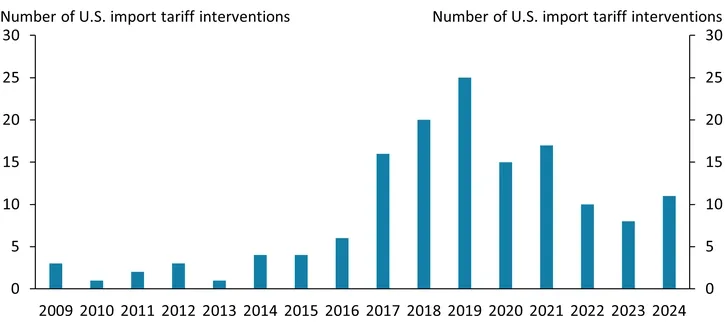
Source: Kansas City Federal Reserve Economic Bulletin, January 17, 2025
How tariffs can impact small businesses
There are a number of ways tariffs may impact small business owners. Here are some of the main ones:
1. Increased costs/lower profits
Small businesses can face higher expenses for imported materials and goods, which can eat into their already thin profit margins. Keep in mind that small businesses often have less purchasing power than large ones, and less ability to influence the government officials who initiate tariffs.
2. Price increases
To offset tariff-related costs, businesses may be forced to raise prices, which could be good or bad for individual businesses. On the positive side, tariffs may make goods from overseas more expensive, which could make prices more competitive for some US producers or sellers.
On the other hand, consumers buy a lot of goods that are sourced from other countries where costs are lower, and small businesses may find their customers are either unwilling or unable to pay higher prices.
3. Supply chain disruptions
This can be a significant problem for small businesses. Remember all the supply chain disruptions that occurred during the pandemic? Tariffs can cause chaos in global supply chains, forcing U.S. importers to struggle with avoiding tariff impacts.
4. Rising costs
Inflation refers to an increase in cost of goods and services. Tariffs can contribute to inflation. As the cost to consumers and businesses go up, they may have less money to spend. Walmart’s finance chief John David Rainey has warned that, “Tariffs are going to be inflationary, there’s no disputing that.”
The Peterson Institute for International Economics says that “Trump’s bigger tariff proposals would cost the typical American household over $2,600 a year.”
5. Trade wars
Tariffs by one country may result in retaliatory tariffs which may make it harder, or more expensive, for US businesses to export their products, and which can lead to trade wars.
The Tax Foundation estimates that “retaliatory tariffs stemming from Section 232 and Section 301 actions total approximately $13.2 billion in tariff revenues.” It also points out that while US-imposed tariffs raise revenue for the US, “tariffs imposed by foreign jurisdictions raise no revenue for the US but result in lower US output.”
6. Slower growth
Uncertainty is part of running a small business, but higher costs and rapid changes in policy may leave businesses less willing to spend or invest.
Industries most likely to be affected by Trump’s proposed tariffs
- Housing and construction: This industry relies heavily on timber, aluminum and steel from Canada, which could become much more expensive if tariffs are imposed on these goods
- Automotive industry: U.S. automakers like Tesla have been significantly affected by tariffs, facing increased costs and having to adjust pricing strategies
- Steel and aluminum industries: These sectors have been at the center of U.S. tariff policies, with recent increases in tariff rates from 0-7.5% to 25% in 2024
- Technology sector: Chip makers and electronics manufacturers dependent on China for sales are particularly vulnerable
- Agriculture: Farmers have experienced significant challenges, with some reporting tariff-induced loss of markets reducing incomes and jobs in farm communities
- Small manufacturers: Various small businesses across industries have struggled, including precision-part manufacturers, industrial metal fabricators, and furniture makers
- Trucking industry: Experts warn that tariffs could intensify the slump in the U.S. trucking industry.
- Smaller ecommerce businesses: Smaller ecommerce businesses that rely heavily on goods from China may find it harder to shift to new suppliers, especially if supply chains become strained and larger businesses are competing for those same products.
These industries are particularly susceptible to tariff-related issues due to their reliance on global supply chains, imported materials, or export markets affected by retaliatory tariffs.
What your small business can do now
Here are steps to consider as US-businesses navigate the possibility of new tariffs and changes in trade policy.
1. Know your numbers
High margin products have more wiggle room when it comes to pricing. That flexibility may allow you to raise prices less aggressively and still make a decent profit margin, even if it’s less than before the tariffs were imposed.
“The higher your margin, the less effect tariffs will have on your business,” Chou points out.
2. Order now
If your business relies on imported goods likely to be affected by tariffs, Chou recommends placing your orders now before new tariffs take effect. (He also warns, however, that the cost of freight will likely be higher as other buyers do the same.)
A small business loan, a line of credit, or even a 0% intro APR business credit card, may allow your business to stock up now without spending a lot of cash. There is the risk that you could find it harder to sell your products or services, though, if inflation increases quickly. Proceed with caution.
3. Research your supply chain
If you can, look into alternative sources for the goods or services you buy. That’s often easier said than done, especially for certain types of businesses that rely on the often cheap but sophisticated manufacturing processes that China has become known for. Consider investigating other options before a possible profit-killing tariff hits.
4. Speak up
If you’re concerned about tariffs, contact your elected officials in Washington to let them know how proposed tariffs may impact your business.
The US Constitution grants Congress the power to collect taxes and duties. But under subsequent Trade Acts, the President may be able to enact tariffs quickly. There have been recent efforts by Congress to “(restore) its authority over these matters,” according to the Yuetter Institute at the University of Nebraska–Lincoln.
Resources: Learn more about tariffs
The US International Trade Commission publishes the Harmonized Tariff Schedule which you can find here. It also includes a change record that can be used to identify changes in tariffs. Warning: it’s a long list.
For those interested in learning more about how tariffs may impact their businesses, here are several resources worth exploring:
Watch Steve Chou’s YouTube videos about his experience with tariffs here and here.
Read Amitrajeet A. Batabyal’s primer on how tariffs work.
The Tax Foundation, a non-partisan, non-profit research organization has published an extensive report on the impact of tariffs. They warned in June 2024 that Trump-Biden tariffs, “the $79 billion in higher tariffs amounts to an average annual tax increase on US households of $625.”
The World Economic Forum has published an extensive guide to predictions about the global economy in 2025, including detailed analysis by individual economists. A key finding: “The majority of chief economists surveyed by the World Economic Forum expect the global economy to weaken in 2025.” One major concern is trade policy.
The Brooking Institute has published a guide, What are tariffs, and why are they rising?, along with related articles on President Trump’s proposed tariffs.