
What’s the difference between business credit vs. personal credit?

Gerri Detweiler
Education Consultant, Nav

Summary
- Personal and business credit reports are maintained separately.
- Business credit lacks the same legal protections as consumer credit.
- Business reports don't usually show creditor names or credit limits, and late payments are tracked by "days beyond terms" instead of 30-day cycles.
- Personal credit can still impact your ability to get business financing, especially when you're starting out or applying for bank loans or SBA loans.
- Separating business and personal credit protects your personal liability and helps you qualify for better financing terms.
Editorial note: Our top priority is to give you the best financial information for your business. Nav may receive compensation from our partners, but that doesn’t affect our editors’ opinions or recommendations. Our partners cannot pay for favorable reviews. All content is accurate to the best of our knowledge when posted.
You probably already know that when you want to borrow money, your credit is one of the first keys to qualifying. The better your credit, the more likely you are to qualify for a loan or financing at lower interest rates and favorable terms.
As a small business owner, you need to pay attention to both personal credit and business credit. Establishing business credit can help you eventually move away from personal credit and personal guarantees, but it takes time to get to the point where you rely solely on business credit.
When you check your business credit for the first time, you may find it confusing or surprising. Understanding the differences — and similarities — between personal and business credit can help you navigate those differences.
Business vs. personal credit compared
Here are key differences between business and personal credit:
Category | Personal Credit | Business Credit |
Score range | FICO®: (most scores) 300–850 VantageScore: 300–850 | Varies by bureau and score. Examples:
|
Major credit bureaus | Equifax, TransUnion, Experian | Equifax, Experian, Dun & Bradstreet |
Free credit reports | Required annually | Not required by law |
Account information | Includes names of creditors reporting | Does not include names of creditors reporting |
Payment history | 30-day increments | Days beyond terms (DBT) |
Credit limits | Usually reported | Often not reported |
Negative information | Fair Credit Reporting Act (FCRA) usually limits derogatory information at 7 years | FCRA does not apply; no limit on reporting periods |
Credit scoring models | Main providers: FICO and VantageScore | Many different models |
Data sources | Personal accounts, loans, credit cards | Trade accounts, business loans, public records |
Privacy | Restricted access under FCRA | Anyone can purchase business credit reports |
What is personal credit?
Personal credit reports track your individual borrowing and payment history. They include:
- Identifying information: Name, addresses, social security number, date of birth
- Current and closed accounts: Mortgages, credit cards, auto loans, personal loans, student loans, plus payment history and balances
- Collection accounts
- Public records: Bankruptcies (formerly judgments and tax liens as well)
- Credit inquiries
While your personal credit score is calculated from the data in your personal credit report, it's sold as a separate product.
Personal credit scores typically range from 300–850. Higher scores are better because they indicate lower risk to lenders.
What is business credit?
Business credit reports show your company's credit history and financial track record, similar to how personal credit reports work for individuals. It’s like a financial “cheat sheet” that lenders, suppliers, and other companies can review when deciding whether to do business with your company.
Most business credit reports include:
- Business background information: Owners, parent companies, subsidiaries, employer identification number, industry
- Business financial information: If available: bank account balances, returned checks, assets, real estate owned, inventory, sales)
- Banking, trade, and collection history: Accounts opened in the business's name and the payment history on those accounts
- Liens, judgments, and bankruptcies
- Credit inquiries
- Uniform Commercial Code filings (UCC filings)
A business credit score might also be sold with a business credit report as well.
Why both credit profiles matter
Your business and personal credit profiles can work together to determine your financing options:
- Lender underwriting: Many small business lenders check both business and personal credit, especially for small business loans and SBA loans.
- Vendor terms: Suppliers use business credit to set payment terms (net-30, net-60) and credit limits.
- Insurance premiums: Insurers may review business credit when setting rates for commercial insurance or surety bonds.
- Lease approvals: Landlords often check business credit for commercial space rentals.
- Business credit cards: Most small business credit card issuers check personal credit but then report payment history to business credit bureaus.
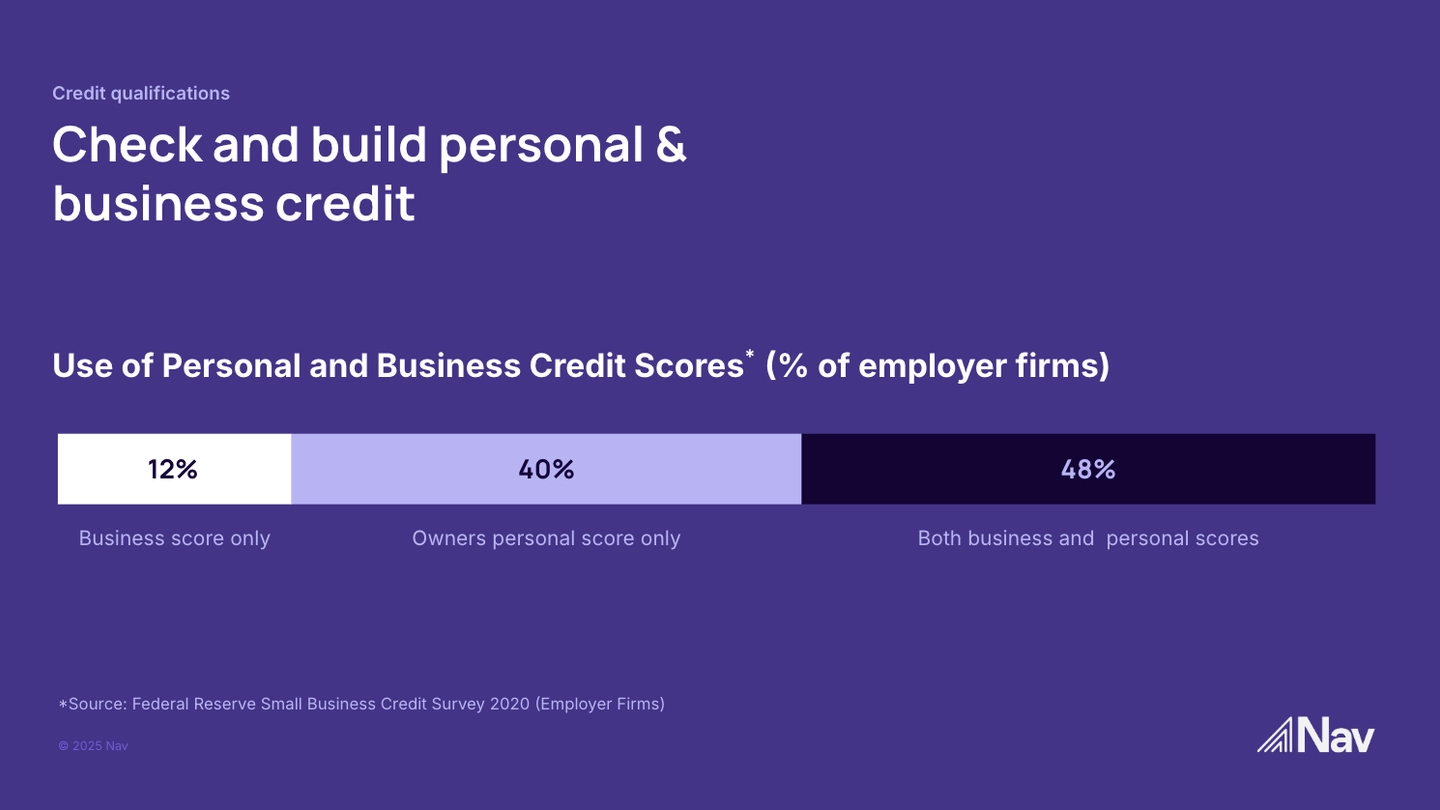
According to research by the Federal Reserve, 48% of business owners who report getting small business financing said both their personal and business credit was a factor in their approval.
How personal credit impacts your business (and vice versa)
When personal credit affects business financing
If you're trying to get some of the best small business loans, including bank loans and SBA loans, your personal credit history often matters, too. Most business credit card issuers review the applicant's personal credit scores (such as VantageScore or FICO scores).
Plus, there are some blended scores that can evaluate both personal and business credit to create a single score, as we will discuss in a moment.
It's common for business lenders to check personal credit, especially when a personal guarantee (PG) is involved.
Lenders and companies that offer business financing will often use a soft credit check when reviewing personal credit. Many times they are looking for red flags like delinquent payments, a very low personal credit score that falls into the "bad credit" category, or bankruptcy.
When business credit can impact personal credit
Personal credit and business credit data are kept separate. That means that generally your personal credit does not directly impact your business credit.
Additionally, most business loans and financing don't appear on personal credit reports. However, those that require a personal guarantee may appear on personal credit if the business doesn’t pay back the loan as agreed. While this isn't common, it is possible for business credit to impact your personal finances.
Example: Most small business credit card issuers don’t report to personal credit unless the loan goes into default (not paid as agreed).
Blended scoring models
Some business credit scores are based upon only the information from a single business credit report. However, a few credit scoring models offer blended scores that can evaluate data from both business and personal credit reports. The main ones are:
- FICO® SBSSsm score
- Experian Intelliscore PlusSM
- Equifax Business Delinquency ScoreTM
- Equifax Business Delinquency Financial ScoreTM
For new business owners with strong personal credit, blended scoring may provide a good starting point. As your business builds its own credit history, the scoring model may shift to focus more on business-specific data.
Myths about business vs. personal credit
Many business owners have misconceptions about how business and personal credit work. Here are the facts:
Myth | Fact |
Getting an EIN automatically creates business credit | An EIN is just the first step. You need credit accounts that report to business bureaus and a payment history to build business credit. |
Business credit completely protects personal assets | While building business credit can help reduce reliance on personal guarantees over time, it does not eliminate the risk to personal assets if a loan with a personal guarantee goes unpaid. Negative tradelines can also affect your credit scores. |
You need perfect personal credit to get business credit | While personal credit helps, you can build business credit even with imperfect personal credit through trade accounts and secured business cards. |
All business credit cards report to business bureaus | Some business cards only report to personal credit bureaus or don't report business credit at all. Always confirm reporting practices. |
Business credit scores work like personal FICO scores | Business scores use different ranges (often 0–100) and focus heavily on payment timing, not just whether you paid. |
Incorporating your business automatically separates credit | Legal separation doesn't guarantee credit separation. You must actively establish business credit accounts and maintain separate finances. |
Late business payments only hurt business credit | If you personally guaranteed a business loan that goes into default, it can appear on your personal credit report too. |
Business credit reports are private | Unlike personal credit, anyone can purchase your business credit report without your permission. |
Steps to separate business and personal credit
If your goal is to build business credit for the first time, you'll need to get credit accounts that will appear on your business credit profile and make on-time payments.
Follow these steps:
1. Form a legal business entity
Become an LLC or corporation if possible. While you can build business credit as a sole proprietor, a separate entity provides better liability protection. Check out Nav’s guide to forming a business entity.
2. Get an Employer Identification Number (EIN)
Get this number from the IRS for your business. An EIN is similar to a Social Security number, but for a business rather than an individual. Sole proprietorships may get EINs too. You can get an EIN for free from the IRS.
3. Open a dedicated business checking account
Use your EIN and business name to open a separate business checking account. Check out great options here.
4. Establish credit accounts that report to business credit bureaus
These accounts, known as “tradelines”, may help establish a payment history with business credit bureaus. They are designed to support business credit reporting. Options for tradelines can include:
- Net-30 vendor accounts
- Business credit cards
- Business lines of credit and loans
- Nav Prime
- Nav Prime Card1
5. Pay all bills on time
Your payment history is the most important factor considered by most credit scoring models. Paying early can help to establish a positive reputation with vendors.
6. Keep business and personal finances separate
Use your dedicated business accounts for all business expenses to make sure your personal expenses don't blend with your business charges.
7. Monitor both your personal and business credit reports
Check your reports regularly to ensure accuracy and track your progress.
For more details, read Nav’s step-by-step guide to building business credit.
How to improve business credit scores
Want to keep more of your hard-earned money? Good credit may help by saving you money on loans, insurance, and even helping your business land more lucrative contracts.
If you want a chance to improve your personal or business credit scores, here are three things you'll want to consider:
- Check and monitor your personal and business credit reports and scores. Not all companies report to business credit, and even when they do, they may not report to all the major business credit bureaus. Check your credit to learn what’s showing up on your business credit reports.
- Pay on time. Payment history is the most important factor considered by most credit scoring models. With business credit, payments that are just a couple of days late may show up on your credit reports. Pay on time, or early if you can.
- Watch debt levels. Debt itself isn't always bad; it's more a matter of how you manage it. Frequent high balances on revolving accounts like credit cards may hurt your scores.
You have no control over which credit bureau or type of credit score a lender uses.
However, you do have at least some control over the information upon which your credit scores are based. Paying on time and keeping a manageable level of debt are two of the best ways to build and protect your credit scores.
Frequently asked questions
Rate this article
This article currently has 12 ratings with an average of 5 stars.
Gerri Detweiler
Education Consultant, Nav
Gerri Detweiler has spent more than 30 years helping people make sense of credit and financing, with a special focus on helping small business owners. As an Education Consultant for Nav, she guides entrepreneurs in building strong business credit and understanding how it can open doors for growth.
Gerri has answered thousands of credit questions online, written or coauthored six books — including Finance Your Own Business: Get on the Financing Fast Track — and has been interviewed in thousands of media stories as a trusted credit expert. Through her widely syndicated articles, webinars for organizations like SCORE and Small Business Development Centers, as well as educational videos, she makes complex financial topics clear and practical, empowering business owners to take control of their credit and grow healthier companies.