
BILL Divvy corporate card review: Complete control over your business spend

Lyle Daly
Financial Writer

Robin Saks Frankel
Senior Content Editor
-1024x576.webp)
Summary
- The BILL Divvy Corporate Card is a corporate charge card that’s part of BILL Spend & Expense, a spending and expense management platform with powerful budgeting tools.
- It earns points on purchases, but the rewards program works differently than those of more traditional business cards.
- This corporate card is ideal for teams that want tighter spending controls and automated expense workflows.
- It doesn't have the typical business card perks, like bonuses and financing offers, instead providing advanced budgeting tools and time-saving expense management software.
Editorial note: Our top priority is to give you the best financial information for your business. Nav may receive compensation from our partners, but that doesn’t affect our editors’ opinions or recommendations. Our partners cannot pay for favorable reviews. All content is accurate to the best of our knowledge when posted.
Nav’s verdict
- A fit for: Businesses with multiple employees looking to streamline expense management.
- Standout feature: Physical and virtual cards for every employee with proactive spending controls.
- Not for: Businesses that need to finance purchases by carrying a balance.
- Biggest drawback: Complex rewards program with restrictions on earning and redemptions.
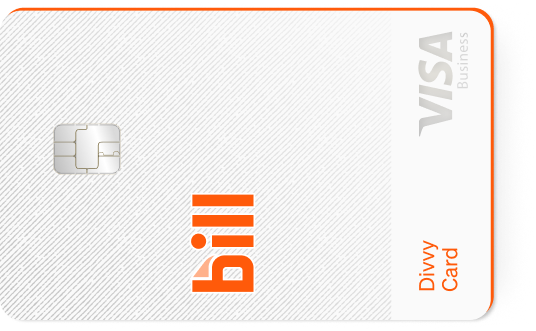
BILL Divvy Corporate Card
Eligibility based more on revenue, requires full repayments monthly.
Pros
- Free and flexible expense management platform
- No annual fee.
Cons
- No early spend bonus and lower rewards than other cards
- Must pay off all balances in full each month.
Intro APR
Purchase APR
Annual Fee
Welcome Offer
If you want a straightforward cash-back card, skip to the alternatives.
BILL Divvy Corporate Card overview
The BILL Divvy Corporate Card is designed for the needs of established companies. As a corporate card, it doesn’t require a personal guarantee from the business owner. Approval is generally based on the business’s financial profile (e.g., cash flow and bank balances) rather than requiring a personal guarantee.
BILL reports account activity to the Small Business Financial Exchange (SBFE®), which is not itself a credit bureau; it is a data exchange that may provide information to participating business credit bureaus. Traditional small business credit cards make the business owner provide a personal guarantee, holding them personally liable for business debt, even if the business closes.
This card is available as part of the BILL Spend & Expense platform. BILL Spend & Expense offers a credit line to businesses, as well as a BILL Divvy Corporate Card for accessing those funds.
Card type | Corporate card |
Annual fee | $0 |
Foreign transaction fee | 1% of transaction |
Payment expectations | Pay-in-full charge card |
Rewards | Up to 7x points, based on payment settings. |
Employee/virtual cards | Unlimited physical and virtual cards |
Credit reporting | Reports to the Small Business Financial Exchange (SBFE), which may report to business credit bureaus |
A fit for | Business owners looking for a scalable credit line and payment controls |
Pros and cons
Pros
- BILL offers flexible credit lines that can scale with your business.
- You can order physical cards for yourself and your employees, or you can get virtual cards to use online.
- The flexible underwriting process is based on business finances and not your personal credit history.
- BILL Spend & Expense reviews are overwhelmingly positive, with customers commenting on how easy it is to manage business expenses.
- The BILL Divvy Corporate Card may help you build business credit history, since it reports your activity to the Small Business Financial Exchange (SBFE®).
- You can connect BILL Spend & Expense to your accounting software and streamline managing your finances.
Cons
- The rewards program has complex restrictions, including a rule that you can’t redeem points for the first 12 months.
- BILL requires that you pay in full by the due date and doesn’t allow you to carry a balance.
- The card charges a small foreign transaction fee.
How the BILL Divvy Corporate Card works
The BILL Divvy Corporate Card helps business owners monitor transactions, control spending with budgets, and set rules for transactions. The system automatically declines charges that exceed the cardholder’s budget or are prohibited by your spending rules.
BILL Spend & Expense provides real-time transaction data, giving you instant visibility to employee spending. It also categorizes transactions, matches them to receipts that employees upload, and syncs data with your accounting software.
Credit lines on the BILL Divvy Corporate Card range from $1,000 to $5 million. BILL’s underwriting process looks at your business’s finances, including revenue, cash flow, and bank account balances, to set a credit limit. If you want to apply for a credit line increase, you can do so in your dashboard.
Rewards and earning structure
The rewards rate on the BILL Divvy Corporate Card depends on your payment frequency and the spending category. The card earns Up to 7x points, based on payment settings.. If you pay off your bill more often, you can earn a higher rate. The card also earns bonus points in certain areas, up to your first $5,000 spent per month in these categories. Here’s a breakdown of its earning structure.
Category | Weekly | Semi-monthly | Monthly |
Restaurants | 7x | 4x | 2x |
Hotels | 5x | 3x | 2x |
Recurring software subscriptions | 2x | 1.75x | 1.5x |
Base rate | 1.5x | 1x | 1x |
Rewards terms and eligibility requirements can change — review BILL’s current rewards terms for details.
Bonus categories and caps
The bonus categories of restaurants, hotels, and recurring software subscriptions could be a lucrative feature, depending on where your company spends money. For example, these bonuses apply to:
- Team meals and client dinners, which typically count as restaurant spending.
- Hotel stays on business trips, which fall under the hotel category.
- Microsoft Office 365, Slack, and other business software.
Multipliers apply to your first $5,000 in monthly spend across the bonus categories. After that, the base rate applies for the rest of the month.
Rewards requirements and restrictions
BILL has several restrictions on rewards:
- If you don’t spend at least 30% of your credit line in a given month, you forfeit any points earned that month.
- Certain types of transactions, including foreign transactions, are ineligible for rewards points.
- You can’t redeem rewards for the 12-month period after you first sign up for a BILL Spend & Expense account.
- You lose all your accrued points if you spend $0 in any given month, you are delinquent or default on your payment at any time, or if you’re not a customer at the end of the initial 12-month period.
Redeeming rewards
You can redeem rewards when you’ve been a BILL Spend & Expense customer for a year and have accrued at least 5,000 points, as long as your account isn’t past due. Redemption options are cash back or gift cards.
Here’s how to redeem your points:
- Go to the Rewards page and “Redeem.”
- Choose a redemption option.
- Enter the amount of points you want to redeem (you must redeem at least 5,000 points).
- Select the fulfillment method.
- Review and confirm your redemption.
Spend management and expense tools
BILL Spend & Expense offers a range of spending tools.
Budgets, approvals, and spend controls
You have total control over your company’s budget and how you allocate its credit line. You can assign budgets to specific employee cards, or create multiple budgets organized by team, location, project, event, or any other expense category.
Employee cards and virtual cards
BILL offers unlimited physical and virtual employee cards. You have the option of setting spending limits on each card and locking cards at any time.
While employees who make in-person purchases will need physical cards, using virtual cards is popular for online and phone orders. A virtual card has a unique card number, protecting your real card. You could also generate a virtual card with a spending limit for each vendor, ensuring that you don’t overpay.
Receipt capture, reimbursements, and reporting
BILL Spend & Expense allows you to upload receipts online or in the app, and it automatically matches receipts to transactions. You can also set up text message reminders to add receipts for yourself and your employees.
If your employees pay for business expenses themselves and request reimbursement later, BILL Spend & Expense offers reimbursement requests. Employees can send requests through BILL, and you, your budget owners, or your managers can review and approve requests.
Integrations and accounting sync
Bill Spend & Expense can integrate and automatically sync with the following business accounting software:
- QuickBooks Online
- QuickBooks Desktop
- Oracle Netsuite
- Xero
- Sage Intacct
Travel and bill pay features
The BILL Divvy Corporate Card offers travel booking powered by TravelPerk. It provides booking, budgeting controls, and rewards. Some bookings may be eligible for flexible changes/cancellations and partial refunds (for example, up to 80%), depending on fare and booking terms. See BILL’s Travel Perk terms for the most current information.
For large invoices, BILL Spend & Expense offers Payments Services, a free vendor payment service. You send BILL a list of your invoices, and it handles the manual payment process for you.
Fees and costs
Here are the fees and other costs of the BILL Divvy Corporate Card:
- Annual fee: $0
- Foreign transaction fee: 1% of transaction
- Late payment fee: 2.99% or $38, whichever is greater
- Returned payment fee: $38
- Subscription fees: $0/month for BILL Spend & Expense
There are also a few potential additional costs to consider:
- If you also need BILL Accounts Payable & Receivable, it costs between $49 to $89 per user per month, depending on the plan.
- The implementation time to set up everything could require several hours of admin labor.
- One or more employees will need to spend time every week monitoring transactions and fund requests.
- All rates and fee are subject to change.
Eligibility and underwriting
BILL requires information on your business, its finances, and its owners when you apply for a card. The underwriting process also requires that you connect your business bank account to BILL using a processor (usually Plaid or MX), and you typically need a cash balance greater than $20,000 to get approved.
BILL reviews your business banking history and monitors your bank account as long as you’re a client. It uses this information to set your card’s initial credit limit and make adjustments to your credit line when appropriate.
What you may need to apply
Here’s what you normally need to apply for the BILL Divvy Corporate Card:
- Business information:
- Legal business name
- Address
- Entity type
- Formation date
- Financial information:
- Annual revenue
- Tax ID or employer identification number (EIN)
- Desired line of credit
- Secure bank connection
- Other information:
- Company owners
- Account administrator
- Verification documents, such as a government-issued ID
Credit limits and payment terms
BILL uses standard and alternative underwriting methods to set credit limits. Unlike traditional small business credit cards with fixed credit limits, the BILL Divvy Corporate Card has a flexible credit line that can change over time.
Since BILL connects to your business bank account, the account balance plays a significant role in your credit line. If your balance increases, BILL may raise your credit limit. Other factors that can affect your spending power include market conditions, BILL’s overall portfolio, public information from business credit bureaus, and your spending and payment history with BILL.
You must pay your card balance in full every billing cycle. BILL offers three billing cycle options:
- Weekly
- Semi-monthly
- Monthly
You can’t carry a balance with the BILL Divvy Corporate Card. If you don’t pay the full amount due on the due date, BILL may charge you a late fee and put a temporary hold on your account. Until the hold is removed, no one can use the physical and virtual cards on your account.
Does BILL Divvy Corporate Card help build business credit?
The BILL Divvy Corporate Cardcan help build business credit. BILL reports activity to the Small Business Financial Exchange (SBFE). Although the SBFE isn’t a credit bureau, it may share data with the major business credit bureaus: Dun & Bradstreet (D&B), Equifax, and Experian.
If you use your BILL Divvy Corporate Card and pay on time, that activity will be shared with the business credit bureaus. This can help you establish business credit.
Customer support and user experience
BILL provides the following customer support options:
- Live chat
- Request a call
- Send a message through the message center
- Self-service support via the BILL Help Center
Live agents are available from 5 a.m. to 6 p.m. PST Monday through Friday and from 6 a.m. to 3 p.m. PST Saturday and Sunday.
Although you can generate virtual cards immediately after approval, expect your business’s overall onboarding process to take at least a few hours. Your admin will need to sync BILL with your business accounting software and set up budgets, and there can be a bit of a learning curve.
Once your admin is used to the BILL Spend & Save platform, it’s easy to manage. The BILL app is also intuitive, and your employees should be able to jump in right away and upload receipts for their purchases.
Best practices: Pilot BILL with one department before you roll it out company-wide. You can see what works and what needs to be adjusted with a smaller group, and then bring on the rest of your staff.
BILL Divvy Corporate Card vs. alternatives
BILL Divvy Corporate Card vs Ramp card
Ramp offers a corporate card with rewards and expense management tools. Ramp requires at least $25,000 in a U.S. bank account linked to your application, similar to BILL’s typical requirements of $20,000. Here are its key differences:
- Flat-rate rewards: The Ramp Card earns a flat rate of up to 1.5% cash back on purchases, without any bonus categories.
- Savings insights: A standout perk, Ramp savings insights are personalized recommendations into how your company can reduce spending.
- 24/7 support: Like BILL, Ramp offers live chat and phone support, but its support team is available around the clock.
BILL Divvy Corporate Card vs. Brex card
Brex also offers a corporate card with expense management tools. It has higher eligibility requirements, as you generally need a cash balance of at least $50,000 to qualify for a Brex card. Here are a few other notable differences:
- Rewards structure: The Brex business card has different bonus categories than the BILL Divvy Corporate Card, earning:
- 7x on rideshares
- 4x on Brex travel (flights and prepaid hotels)
- 3x at restaurants
- 2x on software
- 1x on other purchases
- No foreign transaction fees: Designed with global businesses in mind, this card doesn’t charge extra on foreign transactions.
- 24/7 support: Brex offers 24/7 live chat and phone support.
BILL Divvy Corporate Card vs. The American Express Blue Business Cash™ Card
The is a traditional small business card. Approval depends primarily on your personal credit, not your business credit, and the card requires a personal guarantee. Here are more important differences in what it offers:
- Flat-rate rewards: The American Express Blue Business Cash™ Card
- More limited spending and expense tools: This card offers employee cards and expense management tools. However, corporate cards provide far better tools and controls.
- Purchase financing: You can carry a balance on this card, and it has a 0% intro APR on purchases for the first 12 months.
Eligibility requirements and benefits may change; confirm current terms with each provider.
Who should get the BILL Divvy Corporate Card
Here’s which types of businesses should and shouldn’t get the BILL Divvy Corporate Card.
A fit for:
- Business owners who need to issue cards to multiple employees.
- Finance teams looking to tighten spending controls.
- Companies that frequently spend on business meals and hotel bookings.
- Businesses that spend heavily on recurring software purchases.
- Owners who want to get a business card with no personal guarantee.
Not a fit for:
- Business owners who want a straightforward cash back card.
- Companies that carry balances from month to month.
- Businesses with low or inconsistent spending.
- Sole proprietors and other businesses without any employees.
How to apply
Follow these steps to apply for the BILL Divvy Corporate Card:
- Select the “Apply Now” option.
- Provide and verify your email address.
- Complete a short questionnaire about your business.
- Fill out the application and connect your business bank account to BILL.
- Submit the application.
The full application process, from start to approval, generally ranges from a few hours to three days. You can issue virtual and physical cards upon approval. Virtual cards are available immediately, and physical cards normally arrive within 14 business days.
The bottom line
The BILL Divvy Corporate Card is great for businesses that need real-time transaction monitoring and tight budget controls. But the rewards program, while potentially valuable, is complicated and has several unusual restrictions. For more simplicity, a flat-rate cash back card, like the Ramp card or a small business credit card, could be the better choice.
Frequently asked questions
Rate this article
This article has not yet been rated
Lyle Daly
Financial Writer
Lyle Daly has been a financial writer for over a decade, covering credit, investing, banking, and more. His work has appeared in The Motley Fool, USA Today, MSN, and Yahoo Finance. As a self-employed writer, he has firsthand experience with managing personal and business finances.
Robin Saks Frankel
Senior Content Editor
Robin has worked as a personal finance writer, editor, and spokesperson for over a decade. Her work has appeared in national publications including Forbes Advisor, USA TODAY, NerdWallet, Bankrate, the Associated Press, and more. She has appeared on or contributed to The New York Times, Fox News, CBS Radio, ABC Radio, NPR, International Business Times and NBC, ABC, and CBS TV affiliates nationwide.
Robin holds an M.S. in Business and Economic Journalism from Boston University and dual B.A. degrees in Economics and International Relations from Boston University. In addition, she is an accredited CEPF® and holds an ACES certificate in Editing from the Poynter Institute.