

Best manufacturing business loans and financing: How to fund your business in 2026

Written byGerri Detweiler

Reviewed by Robin Saks Frankel

Summary
- Manufacturing financing got a major upgrade in 2025–2026; new SBA programs and policies to support manufacturing offer expanded access to capital.
- The right loan depends on why you need financing, whether that’s for equipment, cash flow gaps, or expansion.
- Manufacturers may have an advantage when looking for financing in the form of collateral such as equipment or accounts receivable.
- Learn how to find the right financing for your manufacturing business.
Manufacturing businesses may be able to access a wide range of financing options, including SBA loans, bank loans, invoice factoring and equipment financing. Having a lot of choices can be both good and bad: options can make it difficult to choose.
That’s why understanding which types of financing may fit your situation, what lenders look for, and the cost of different types of financing, can help you choose the ones that are the best fit for your business.
Best manufacturing loans and financing options
Not every financing tool is right for every manufacturing situation. When you’re choosing you need to consider what you need the money for, how quickly you need it, and what your business qualifies for.
Here is a quick overview to help you find options for the most common manufacturing financing scenarios:
Best options by situation
Situation | Best financing type | Runner-up option | Key tradeoff |
Buying or upgrading equipment | Equipment financing or SBA 504 | SBA 7(a) | Speed vs. cost: equipment loans can be faster while SBA loans can be cheaper |
Covering raw materials before a production run | Business line of credit | SBA MARC revolving line | Not all small businesses meet bank loan requirements, and not all small businesses meet SBA loan requirements |
Bridging slow-paying customers on net terms | Invoice factoring / A/R financing | Asset-based lending | Must invoice creditworthy business-to-business (B2B) customers |
Funding a surge in orders or a new contract | Bank line of credit or MARC line | Purchase order financing | Higher cost for speed; evaluate ROI before committing |
Expanding space or adding a second facility | SBA 504 or SBA 7(a) | Bank term loan | Lowest cost but can require the most time and documentation |
Startups with strong purchase orders but limited history | Purchase order financing | Invoice factoring | Typically depends on customer creditworthiness, not manufacturer |
Bad credit but strong receivables or collateral | Invoice factoring or asset-based lending | Equipment financing | Underwriting focuses on asset quality, not owner credit |
What is a manufacturing business loan?
Manufacturing business loans are financing products designed to address the specific capital needs of production companies. That can include purchasing equipment or raw materials, covering payroll during a ramp-up, or expanding a facility.
The types of financing we’ll cover may be used by a wide range of manufacturers: job shops, contract manufacturers, food producers, industrial suppliers, and specialty makers of all kinds.
Most manufacturing financing falls into one of two broad buckets.
- Asset-backed financing, where the loan is secured by something tangible, such as equipment, accounts receivable, or inventory.
- Cash-flow-based financing, where the lender underwrites based on the business's revenue, financial history, and ability to repay.
As you’ll discover in a moment, not all types of financing are loans. Some involve advances of expected future sales, or the purchase of invoices that have been billed but not yet paid.
Understanding which bucket you're working in matters because it shapes what type of financing is the best fit, how fast you can get funded, and what it will cost.
Why manufacturing financing is different
Manufacturing businesses face a financing challenge that most service businesses don't: the gap between when cash goes out and when cash comes back can be a long time. That gap can create cash flow problems.
The manufacturing cash flow cycle
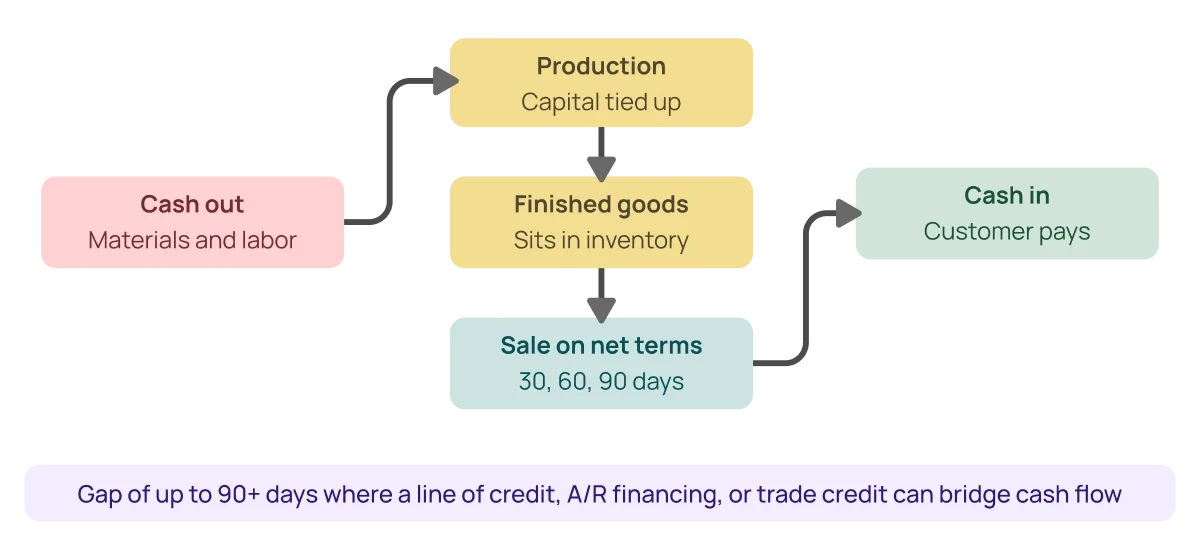
Here is what that cycle typically looks like. First, you purchase raw materials and pay labor — cash out. Then production runs, and capital is tied up in work-in-progress. Finished goods sit in inventory until a sale is made. Once sold, the customer usually pays on net terms — 30, 60, or even 90 days later. Only then does cash come back in.
For small manufacturers, this cycle can stretch up to 90 days or longer. That can be a long time to wait, and it is why the right financing tool for a manufacturer may not be the same one that works for other types of small businesses.
Manufacturers often rely on key metrics for evaluating their cash flow cycle:
- Days sales outstanding (DSO): The average number of days it takes to collect payment after a credit sale
- Days inventory outstanding (DIO): The average number of days a firm holds inventory before selling it
- Days payables outstanding (DPO): The average number of days the manufacturer takes to pay back accounts payable
Manufacturers do have an advantage over some other types of businesses when it comes to financing options in the form of collateral. Equipment, accounts receivable, and inventory all have tangible value that lenders can evaluate and lend against.
That means manufacturers often have access to asset-backed financing options — such as equipment loans, invoice factoring, and asset-based lending — that are not available to businesses with fewer hard assets.
What can manufacturing financing be used for?
Below you’ll see the main types of financing available to small manufacturers. For each one, consider three core tradeoffs:
- Cost: typically, the lower the rate, the more documentation and time required
- Speed: the faster you can get funded, the more it typically costs, and
- Flexibility: how freely you can use the funds and draw them as needed
SBA loans for manufacturers
SBA-guaranteed loans are often among the lowest-cost options available to small manufacturers that qualify. Because the SBA guarantees a portion of the loan, participating lenders can offer better rates and terms than they might otherwise. The tradeoff is two-fold:
- Qualifications: Borrowers must meet SBA loan requirements for business size, citizenship, and more. Learn more about SBA loan requirements in Nav’s guide.
- Time: SBA loans typically take 60 to 90 days or longer to close
If you qualify, you may also benefit from the fact that the SBA has waived upfront fees for qualifying small manufacturers: 7(a) manufacturing loans up to $950,000 carry a 0% upfront fee, and all 504 manufacturing loans carry a 0% upfront fee and a 0% annual service fee. This fee waiver applies to loans made in fiscal year 2026 (Oct. 1, 2025 through Sept. 30, 2026). Note that the fee waiver does not apply to MARC loans, which are subject to standard SBA fee schedules.
SBA 7(a) loans
The 7(a) is the SBA's flagship loan program and the Standard 7(a) is the most popular loan offered. The maximum loan amount is $5 million, and funds may be used for working capital, real estate, equipment, or debt refinancing in certain circumstances. Repayment terms run up to 10 years for equipment and working capital, and up to 25 years for real estate. Interest rates are negotiated between borrower and lender but must stay within SBA-set maximums.
Best for: Working capital, equipment purchases, expansion, real estate acquisition
Timeline reality check: Plan on 60 to 90 days minimum.
SBA 504 loans
SBA 504 loans are designed for major fixed assets: real estate, construction, and long-term machinery and equipment with a useful remaining life of at least 10 years. Manufacturers may borrow up to $5.5 million per project through the SBA portion of the loan. Note that’s per project, not per borrower.
A typical 504 loan is structured in three parts: up to 40% through a Certified Development Company (CDC) backed by SBA, up to 50% or more from a private lender, and at least 10% from the borrower. The CDC portion carries a fixed long-term interest rate, which makes 504 loans particularly attractive for manufacturers making large capital investments in facilities or heavy equipment.
SBA MARC loans (new in 2025)
The Manufacturers' Access to Revolving Credit (MARC) program is a relatively new 7(a) loan program, launched in 2025 specifically for small manufacturers. It was designed to give manufacturers flexible working capital with less red tape than traditional SBA loan programs.
Key features of the MARC program:
- Eligible businesses must be engaged in manufacturing (NAICS codes 31–33)
- Maximum loan amount is $5 million
- Can be structured as either a revolving line of credit or a term loan
- Revolving loans carry a maximum maturity of 20 years (with the revolving period capped at 10 years, followed by a term-out period)
- Term loans carry a maximum maturity of 10 years
- Funds may be used for any short-term working capital need — inventory purchases, new projects, and similar uses
- Can leverage the available equity of existing facilities or equipment
- May be combined with other SBA and conventional commercial loans
- No minimum required equity injection based on use of proceeds (unlike standard 7(a) loans)
SBA International trade loan (expanded for manufacturers in 2026)
In April 2026, the SBA expanded its International Trade Loan (ITL) program specifically for manufacturers. Starting May 1, 2026, manufacturers in NAICS sectors 31–33 became eligible for an expanded ITL program offering a 90% SBA guarantee — significantly higher than the standard 75% guarantee on most 7(a) loans.
The expanded ITL can be used to upgrade or replace equipment, modernize facilities and production lines, or diversify supply chains. It is intended to support manufacturers looking to reduce reliance on foreign suppliers and reshore production.
SBA Export loans
The SBA offers dedicated loan programs for businesses that export outside the United States, as well as those who are trying to break into exporting.
Export Working Capital loans offer up to $5 million and can provide funding in advance of finalizing an export sale or contract, giving exporters flexibility in negotiating payment terms.
Export Express loans do not require SBA approval, meaning they can be approved more quickly. The maximum loan amount is $500,000.
Bank term loans
Traditional bank term loans remain a strong option for larger, planned manufacturing investments with predictable payback periods — facility upgrades, equipment packages, or expansion projects. Banks may offer fixed or variable rates.
Banks will expect to see strong financials, sufficient collateral, and a clear use of proceeds. As of Q3 2025, roughly 9% of banks (on net) reported tightening credit standards on commercial and industrial loans to small firms, with economic uncertainty cited as the primary reason. That means strong financials that show your business can repay the loan matter even more now.
Good fit if: You have established financials, strong qualifications (credit and revenue), can wait 30 to 60+ days for funding, and are making a significant investment with a useful life that justifies a longer repayment term.
Not ideal if: You need funds quickly, have thin financials, or are a younger business without a track record.
Business lines of credit
A business line of credit has been a traditional source of working capital for small manufacturers. Both traditional lenders and online lenders offer lines of credit, and a revolving structure — draw, repay, draw again — makes them well suited for the cyclical nature of manufacturing operations: seasonal inventory builds, materials purchasing ahead of production, and payroll timing gaps.
Watch out for:
- Renewal risk: Lines of credit are often renewed annually. A lender can reduce or close your line at renewal, which can be disruptive if you are in the middle of a production cycle.
- Fees: Unused line fees, origination fees, and annual fees can add up. Understand the total cost, not just the interest rate.
- UCC filings: Lenders may file a blanket UCC lien on your business assets when you get a line of credit. This can affect your ability to obtain other financing.
- Mismatched financing: A line of credit is designed for short-term needs. Using it to fund a multi-year equipment purchase will often be expensive and creates a mismatch between the asset's life and the repayment timeline.
Equipment financing and leasing
Because manufacturing equipment is easily collateralized, equipment financing is one of the most accessible options for manufacturers. The equipment itself secures the loan, which gives lenders some confidence they can recover value if the borrower defaults.
That said, lenders don’t really want to repossess equipment. It will often depreciate (be less valuable over time), and it may be difficult and expensive to take back and then resell. The more specialized or customized the equipment, the more difficult it will be for the lender to recover the value.
There are two main ways to pay for equipment over time: equipment loans and equipment leases.
Equipment loan | Equipment lease | |
Ownership | You own the equipment | Lessor retains ownership during lease |
Best for | Long-term use, building equity | Preserving cash, short useful life, upgrade equipment more frequently |
Down payment | Typically 20% or more | Often lower or none |
Watch out for | Total interest cost over term, risk that equipment becomes obsolete | Residual purchase options; end-of-lease terms |
Manufacturing equipment may not be the only asset you can finance or lease. Most lenders consider any tangible asset used to do business — including office furniture and computer equipment — may be eligible for equipment financing.
Manufacturer-specific considerations: Lenders will typically want to see the equipment specifications and purchase price so have vendor quotes ready before you apply. For used equipment, expect additional scrutiny. An appraisal may be required.
Beyond standard equipment financing, the SBA 504 program is often one of the best long-term options for major equipment purchases. It offers fixed rates and long terms, specifically allowing financing for machinery with a useful remaining life of at least 10 years, including AI-supported equipment related to the project or machinery for manufacturing products.
Invoice financing and factoring
Factoring has been around for a long time and is a fast and practical way to access capital tied up in outstanding invoices. Many manufacturers successfully use factoring to get today the cash that might otherwise be tied up with a customer invoice for 60, 90 days, or even longer.
It is important to understand the difference between invoice financing and invoice factoring:
Invoice financing (A/R lending) | Invoice factoring | |
Who collects | You collect from your customers | The factor collects from your customers |
Speed | Fast — often 24 hours | Fast — often 24 hours |
Advance rate | Typically 80%–90% of invoice value | Typically 85%–90% of invoice value |
Best for | Businesses that want to maintain customer relationships | Businesses that want to outsource collections |
Key tradeoff | Loan against receivables; you retain collection responsibility | Selling receivables at a discount; factor takes over collections |
Watch out for | Interest accrues until customer pays | Customer notification; some customers react poorly to factoring |
Factoring is not technically a loan. You are selling your accounts receivable at a discount to access capital now, rather than waiting for customers to pay their invoices. The factor typically pays an advance of 85%–90% of the invoice value upfront, then remits the balance — minus their fees — once they collect from your customer.
Factors (the companies that offer factoring) often work within specific industries, including manufacturing, because they understand the payment cycles in those industries and can evaluate the creditworthiness of your customers.
Although some factors allow you to continue collecting directly, most will collect from your customers themselves. In some industries, including many types of manufacturing, factoring is very common.
What matters most to factors: The creditworthiness of your customers (not necessarily yours), invoice aging, customer concentration, and dispute risk are often major considerations in the terms you’ll get. A strong customer base with clean, undisputed invoices will get you better advance rates and lower fees than a concentrated or aging receivables portfolio.
Asset-based lending
Asset-based lending (ABL) is a flexible working capital option for manufacturers that have strong assets — accounts receivable, inventory, and equipment — but uneven or lumpy cash flow. Where a traditional bank loan underwrites primarily from cash flow, an ABL facility underwrites based on a borrowing base — typically a percentage of eligible receivables and sometimes inventory.
Best for: Growing manufacturers with substantial receivables or inventory who need working capital that scales with their business. ABL availability goes up as your invoices and inventory go up, which makes it a good fit for manufacturers managing seasonal demand or a large new contract.
Common requirements: Lenders will focus on accounts receivables aging (A/R aging), inventory type and turnover, concentration of customers, and the ease of liquidating the collateral. Regular reporting — often monthly borrowing base certificates — is typically required.
Inventory financing
Inventory financing allows manufacturers to borrow against the value of raw materials or finished goods. It is particularly useful for seasonal inventory builds, long lead-time purchases, or large production runs where you need to buy materials well before you can sell the finished product.
Lenders look at the type of inventory, how quickly it is likely to sell, what it’s worth, and how easy it would be to liquidate if needed.
Here’s an overview of inventory financing options:
Inventory type | Best for | Lender concern | Watch out for |
Raw materials | Preproduction purchases | Commodity volatility; liquidation value | Materials that spoil or become obsolete |
Work-in-progress | Rarely financed | Difficult to value and liquidate | Most lenders will not advance against WIP |
Finished goods | Bridging time-to-sale | Turnover rate; end-market demand | Slow-moving inventory reduces borrowing base |
Purchase order financing
Purchase order (PO) financing is designed for one of the most common manufacturing pain points: you have a confirmed order you can't afford to fulfill. A PO financing company advances funds to pay your suppliers or manufacturers so you can produce and deliver the order, then collects repayment from the proceeds once your customer pays.
When it works best: B2B transactions with reputable buyers, clear margins, and a defined fulfillment process. PO financing providers will evaluate the creditworthiness of your customer (the buyer on the purchase order), not primarily your own credit profile.
Limitations: PO financing is often more expensive than other options and may not cover all of the costs associated with fulfilling an order. It is best used as a bridge for specific, high-confidence orders with a clear path to payment.
Trade credit and net terms
One of the most underappreciated sources of working capital for manufacturers is supplier credit; these are the payment terms suppliers extend to clients. Many will offer terms of net-10, net-30, or even net-60 (or longer) to established customers. Net-30 terms means the buyer has thirty days to pay for the items purchased.
When managed well, trade credit is often interest-free short-term financing that can meaningfully extend your cash runway.
Here’s an overview of how trade credit can benefit your manufacturing business:
Goal | Action | How to negotiate | Risk to avoid | How it may affect business credit |
Extend payment runway | Request payment terms with key suppliers | Start with your longest-standing suppliers; if needed, offer something in exchange (volume commitment, early payment discount) | Over-extending — stacking too many vendor balances can strain supplier relationships | Trade lines paid on time may report to business credit bureaus and help build your business credit profile |
Preserve cash during ramp-up | Use supplier terms to bridge the gap to customer payment | Align supplier terms with your customer payment cycle | Missing due dates — even one late payment can damage your supplier relationship and your business credit | Late payments on trade lines hurt your business credit score |
Reduce reliance on high-cost financing | Build a network of suppliers offering terms | Demonstrate payment consistency over time | Taking on more trade credit than your cash flow can service | Consistent payment builds a positive credit history |
Best practice: Pay on time, every time. A track record of on-time payments with suppliers is one of the foundational building blocks of business credit — and a well-established credit profile can open the door to better, cheaper financing options over time.
Short-term online loans and revenue-based financing
Short-term loans from online lenders can provide fast access to capital, often with same-day decisions and funding within as few as 24 to 48 hours. That speed may come at a cost: Short-term business loans are typically more expensive than SBA loans or bank financing.
These products can make sense for manufacturing businesses with a specific, high-ROI use case and a short payback window. A defined return on investment is critical; you need to be confident that the revenue generated by putting the money to work will comfortably cover the cost of the loan.
Stress-test your lending scenario by asking yourself:
- What is my worst-case scenario if the expected revenue is delayed by 30 or 60 days?
- Do I have enough cash reserves to absorb a production disruption?
- Is the margin on this project sufficient to cover both the cost of the financing and a reasonable profit?
How to qualify for manufacturing loans
The qualifications needed to get approved depend heavily on the type of financing. Here is an overview of what each financing category typically requires:
- Invoice factoring primarily considers the quality of your outstanding B2B invoices and the creditworthiness of your customers. Business credit may be checked, but strong personal credit is often not required or will be evaluated more flexibly.
- SBA and bank loans almost always require strong financials and good credit — both business and personal. The MARC program specifically requires lenders to document the borrower's debt service coverage ratio (cash flow from operations divided by total debt service) at 1:1 or greater on a historical basis, or for startups, at least 1:1 within two years from first disbursement.
- Term loans from online lenders typically require good personal credit scores and will review business bank account statements to verify revenues.
- Equipment financing is often more accessible than other options because the equipment serves as collateral. Lenders focus on the asset's value and condition, which can offset weaker credit in some cases.
Approval rates for small business credit vary meaningfully by credit risk profile. Low-credit-risk firms are approved at roughly 76% to 83% rates at banks, while medium- and high-credit-risk applicants may see approval rates closer to 50%.
How much can you borrow?
Loan amounts vary widely depending on the financing type and your business's qualifications. The table in the "Types of manufacturing loans" section above shows typical loan ranges. As a general reference:
- SBA 7(a): Up to $5 million (standard); combined 7(a)+504 up to $10 million for eligible manufacturers
- SBA 504: Up to $5.5 million per project for manufacturers in NAICS sectors 31-33 (SBA debenture portion)
- SBA MARC: Up to $5 million
- SBA Export Working Capital: Up to $5 million
- SBA Export Express: Up to $500,000
- Equipment financing: Varies widely; can reach $50 million or more for large commercial equipment
- Invoice factoring: Based on your receivables volume; some factors work with portfolios up to $5 million or more
- Short-term loans: Typically up to $500,000
Documents you need to apply
Being prepared with the right documentation before you start the application process can significantly reduce your time to funding and improve your chances of approval. Here is what manufacturing lenders typically ask for:
Document | Who provides it | Why it matters | How recent |
Business tax returns | You / accountant | Primary proof of income and profitability | 3 most recent years |
Year-to-date financial statements | You / accountant | Shows current performance | Within 60–90 days |
Balance sheet | You / accountant | Shows assets, liabilities, and net worth | Current |
Business bank statements | Your bank | Verifies cash flow and revenue | 3–6 months |
Debt schedule | You / accountant | Lists all outstanding business debt | Current |
Accounts receivable aging report | You | Shows quality and age of outstanding invoices | Current |
Inventory summary | You | Valuation and composition of inventory | Current |
Major customer list | You | Assesses customer concentration risk | Current |
Purchase orders or contracts | You / customers | Confirms confirmed future revenue | Active/current |
Equipment quotes | Vendor | Documents the asset being financed | Current quote |
Entity formation documents | State of formation | Confirms business structure and ownership | As issued |
Personal financial statements and tax returns | Each owner with 20%+ stake | Required for personal guarantee evaluation | Most recent year |
For SBA loans, the lender must document the complete ownership structure of the applicant business, including all direct and indirect ownership. Be aware that as of March 1, 2026, all direct and indirect owners must be U.S. citizens or U.S. nationals with a U.S. principal residence to qualify for SBA loan programs including 7(a), 504, MARC, and ITL.
Preparation is key. Make sure your bookkeeping is up to date. If your tax returns show an unusual year or a non-recurring event, be ready to explain it proactively.
How to apply for manufacturing financing
Here’s a step-by-step guide to applying for manufacturing financing.
Step 1: Define your goal
Before you choose a financing product, get specific about what you need. Are you buying equipment? Bridging a gap between customer payment and materials cost? Funding expansion? The use of proceeds determines which financing type is the right fit — and choosing the wrong type can cost you time, money, and a hard inquiry on your credit.
Step 2: Choose your likely financing type
Match your use case to the financing types outlined above. Use the Best options by situation table as a starting point in your research. If your need is long-term and cost is the priority, consider an SBA or bank loan. If you need capital within 48 hours, look at short-term online lenders, invoice factoring, or equipment financing.
Step 3: Gather your documents
Pull tax returns, bank statements, financial statements, and your debt schedule before you contact a lender. Being prepared can accelerate the process significantly.
Step 4: Shortlist lenders
For SBA loans, you need to work with an SBA approved lender. For the MARC program specifically, lenders that have completed SBA's MARC training are the right starting point. For online lenders and equipment financing, compare at least two or three offers before committing.
Step 5: Apply and respond to underwriting
Submit your application and respond promptly to any requests for additional information. Expect some back and forth as the lender evaluates your application.
Step 6: Compare offers and close
Before signing, compare the annual percentage rate (APR) and full payment schedule across any competing offers. Understand fees, not just the interest rate. Ask questions if you don’t.
Once you close, monitor your credit profile, financial ratios, and financing needs at least annually to stay ahead of your next capital need.
Alternatives to manufacturing loans
Loans are not the only way to fund a manufacturing business. Depending on your situation, these alternatives may be worth exploring:
Alternative | Best for | Upside | Downside | When to avoid |
Supplier trade credit | Ongoing materials purchasing | Effectively 0% interest financing if paid on time; may build business credit | Requires supplier relationship and approval; not always available | Late payments damage credit and supplier relationships |
Small, recurring purchases | Convenience; float; rewards; builds business credit | High rates if not paid in full; not suited for large capital needs | For large one-time equipment or facilities purchases | |
Equity investment | High-growth manufacturers with scalable product | No debt repayment obligation | Dilution of ownership; may require board or investor reporting | When you want to maintain full ownership and control |
Grants | Specific projects (reshoring, R&D, workforce) | No repayment required | Highly competitive; restricted use; time-consuming applications | When you need capital quickly |