Business loans with no credit check: Compare options for bad credit

Written byGerri Detweiler

Reviewed by Robin Saks Frankel

Summary
- Many small business lenders check credit, especially for newer businesses.
- Some options may not require a traditional credit check, though some providers may still review credit reports or use soft inquiries.
- Financing options that don’t require a credit check are often based on business revenue.
- Business owners with no credit or bad credit may want to look for options that don’t involve credit checks.
Finding financing for your small business can be hard enough without worrying about whether your credit will stop you from qualifying.
Business loans with no credit check — or financing options with flexible credit requirements — do exist. Understanding how they work can open doors you might not have known were available, and keep you from falling for scams or predatory financing.
Compare business loans with no credit check (2026 shortlist)
Not all no-credit-check financing works the same way. Below is a quick look at the most common types of flexible-credit financing available to small businesses, along with what each is best for.
Financing type | Best for | Typical funding speed | Typical cost structure | Main requirement |
Merchant/business cash advance | Businesses with strong daily card or deposit volume | 1–3 days | Factor rate (1.09–1.5+) | Bank or merchant account statements |
Invoice factoring/financing | B2B businesses with outstanding invoices | 24–48 hours | Percentage of invoice value | Creditworthy customers |
Equipment financing | Purchasing or upgrading business equipment | Days to weeks | Fixed payments; equipment secured | Equipment value; moderate credit |
Vendor/net-30 terms | Buying supplies and building business credit | Immediate on approval | Net 10–60 days to pay; often no interest | Business registration; vendor review |
SBA microloan | Startups and underserved borrowers | Weeks | Low interest; up to $50,000 | Varies by intermediary lender |
Business line of credit | Ongoing working capital needs | Days to weeks | Variable interest on amount drawn | Credit score, revenue, time in business |
Crowdfunding | Businesses with an engaged audience or compelling story | Weeks to months | Platform fees; rewards or equity | Substantial marketing effort; loyal following |
Hard money loans | Real estate investors | Days to weeks | Interest costs tend to be higher than conventional loans | Property with strong after repair valu |
Why business owners seek no credit check financing
There are a number of reasons why you may not want a credit check when you’re trying to get financing for your business.
Protect your credit scores
A hard credit inquiry can lower your credit scores by a few points, while soft inquiries typically do not affect your scores. The effect of a hard inquiry is often small, and short-lived, but if your credit isn’t strong, or you plan to apply for a mortgage or other personal financing, you may want to minimize those inquiries.
Low credit scores
It’s never a good feeling to get rejected for credit, and if you know your credit may be an issue you may not want to take the risk.
Separate personal and business finances
While credit checks and personal guarantees are sometimes related, one does not necessarily determine the other.
Can you get a business loan with bad personal credit?
It may be possible to get a business loan even if you have bad personal credit, but you won’t have as many options as you will if your credit is good — especially if your business is young or not making a lot of money.
It’s not uncommon for lenders to check personal credit for business loans. Negative information like late payments, collection accounts, or bankruptcies may lower your credit scores.
Even lenders who don’t check credit scores may review credit reports to look for items that may disqualify borrowers such as a bankruptcy that hasn’t been discharged or a large number of delinquent accounts.
Business owners with bad credit are more likely to get financing if their business can demonstrate strong income. Revenue-based financing often looks more at whether your business can generate the cash flow to pay it back — not what your personal credit scores look like.
Types of business financing that don’t require traditional credit checks
Several types of financing don’t typically check or rely heavily on personal credit scores. Every lender is different, though, so be sure to ask if this is a concern.
Revenue-based financing
With a business cash advance (or merchant cash advance), the business gets an advance against future revenues, based on past sales. Business cash advances (or merchant cash advances) are typically available to businesses with strong cash flow, backed up by merchant account or business bank account statements.
Payment processor financing
If you use a payment processor like PayPal or Stripe, or if you sell on Amazon, you may be invited to apply for financing. These types of companies typically use information about your prior sales history to decide how much to offer as an advance against future sales. Again, sales are the key qualification, rather than credit.
Asset-based financing
Here your business gets financing based on collateral. Invoice factoring and invoice financing helps businesses that invoice other businesses to get paid faster. With invoice factoring, the business will get an advance against outstanding invoices.
If you’re specifically looking to purchase equipment, such as heavy machinery or a computer, equipment financing may be an option, and some lenders are more flexible when it comes to credit scores. A down payment may be required to avoid a credit check or personal guarantee.
Vendor and supplier credit
Your vendors or suppliers may offer short-term financing for products you purchase directly from them. Net-30 terms give your business 30 days to pay an invoice, for example. This type of financing typically doesn't require strong personal credit, and may not require a personal credit check in some cases. A business credit check may or may not be required.
Crowdfunding platforms
With crowdfunding, you raise money on online platforms. Most crowdfunding sites don’t require a personal credit check, and little financial documentation is required for certain types of crowdfunding, like rewards-based crowdfunding.
You can raise money for your business either by offering rewards or equity in your business. Backers are more interested in your business and its products than your credit score. Loan-based crowdfunding is also an option, though there may be a credit check.
Merchant cash advances and business cash advances
Merchant cash advances and business cash advances may be among the most accessible financing options for small businesses with limited or no credit. They're fast, flexible, and don't put much weight on credit history. But they come with trade-offs that are worth understanding before you apply.
How do merchant cash advances work?
Here’s the process for most merchant cash advances:
Step 1: Application
You apply for the advance, often online. You’ll either link your bank or merchant account or supply three to six months of business bank account or merchant account statements so revenue can be verified.
Step 2: Offer
If your business qualifies, an offer will be made. It will include an advance amount, a factor rate, and a holdback percentage (the amount to be held for future payments).
Step 3: Funding
If you accept the offer, funds will be deposited into your account, usually within a day or two.
Step 4: Repayment
The provider will debit a fixed percentage of your sales receipts — called the holdback — until the advance is paid in full. Holdback rates are typically between 10% and 20% of daily receipts.
Here’s a simple example: Let’s say you accept a $10,000 advance at a factor rate of 1.5. You multiply the advance amount by the factor rate to understand how much you need to pay back: $10,000 × 1.5 = $15,000 total repayment.
That means the cost of the advance is $5,000, and it will be paid back through holdbacks from your merchant account. If your business deposits $5,000 on a given day and your holdback rate is 15%, for example, your payment for that day would be $750. A slower day with $3,000 in deposits could mean a $450 holdback.
There may be minimum payments or fees that can affect the cost or repayment schedule so be sure to understand the full cost.
This is different from a traditional loan with fixed monthly payments. On slower days, you pay less. On stronger days, you pay more. The trade-off is that the effective cost — expressed as an equivalent APR — is typically much higher than a traditional loan. When expressed as an estimated annual percentage rate (APR equivalent), costs can vary widely. A low factor rate can be comparable to roughly 35% APR; high factor rates can reach 350% APR or more,
Merchant cash advance pros and cons
Invoice financing and invoice factoring
If your business invoices other businesses for goods or services, invoice factoring or invoice financing may be an option even if your personal credit isn't strong. Both products help you access cash faster by leveraging the value of your unpaid invoices.
Invoice financing allows you to borrow against the value of outstanding invoices.
With invoice factoring, the factoring firm purchases your invoices outright at a discount, advances cash immediately, and in some cases collects payment directly from your client.
When does invoice factoring make sense?
Invoice factoring can be a good fit for businesses that:
- Invoice other businesses (B2B)
- Have creditworthy customers
- Need to improve cash flow
- May not have access to traditional financing
With invoice factoring, your customer’s credit is generally more important than you or your own business’s credit. The factoring company is relying on your customer to pay the invoice, and will carefully look at its credit rating.
Recourse vs. non-recourse financing
Make sure you understand whether financing is on a recourse or non-recourse basis.
Recourse factoring means that if your customer doesn't pay the invoice, your business is responsible for repaying the advance. The factor can come back to your business for the unpaid amount.
Non-recourse factoring means that if your customer is unable to pay — due to bankruptcy or insolvency, for example — the factor absorbs the loss. You are not liable for uncollectible invoices.
Non-recourse factoring may cost more because the factor takes on additional risk.
Equipment financing with flexible credit requirements
If you need to purchase equipment — machinery, vehicles, computers, or other business assets — equipment financing may be a realistic option even if your credit isn't where it needs to be for a traditional loan.
The collateral can help reduce the risk to the lender. But don’t assume there won’t be a credit check. There may be. However, credit requirements may be more flexible than unsecured loans due to the collateral.
Lenders may check business and/or personal credit. Typical minimum credit scores for equipment financing may range from 550 to 680, depending on the lender, and minimum time in business may be six months to a year or more. A down payment may be required, especially if your credit isn’t strong or your business is newer.
Business lines of credit without hard credit checks
Business lines of credit give you access to credit you can borrow against when you need it. You pay interest on the amount you borrow. Once you repay the debt you’ve borrowed, you can borrow again.
It’s difficult to get a line of credit without a credit check. Most lines of credit are unsecured, which means there is no collateral. Without that added security, lenders typically look for at least fair to good credit.
But some lenders will prequalify your application with a soft credit check that doesn’t affect your credit scores. If you decide to accept the offer, there may be a hard credit check.
While each lender has its own requirements, qualifications for business lines of credit may include:
- Personal credit scores of at least 620-680 or higher
- Minimum of 3-36 months in business
- Annual revenue of at least $120,000
Online lenders typically have more flexible requirements than banks.
Alternative funding options for businesses with no credit
Microloans
Microloans are smaller loans, usually made through nonprofit community-based organizations that offer funding to borrowers who otherwise have trouble accessing conventional financing.
The SBA Microloan program makes loans up to $50,000, though the average loan amount is closer to $16,000.
Best for: Early-stage businesses, underserved borrowers, and entrepreneurs who need smaller amounts of capital and may benefit from the business education support that often accompanies microloan programs.
Business credit cards for bad credit
The majority of business credit cards require good to excellent credit, but there are exceptions. Secured cards and some charge cards may not require good credit or even credit checks. Cards that report to business credit bureaus can help build business credit if paid on time. And some cards offer rewards such as cash back or travel rewards.
Best for: Business owners who want to track business expenses, earn rewards, and/or build business credit.
Retirement account loans/funding
You can usually borrow against your 401(k) retirement account without a credit check. (But if you leave your job, you may need to pay back the balance right away.) Another option may be a Rollover for Business Startups (ROBS) plan, which allows you to use existing retirement savings to fund your business directly.
There can be tax implications to using retirement funds for your business, so always check with a tax advisor before going this route.
Best for: Business owners who have substantial retirement savings and need startup or early-stage capital with no credit requirements.
Hard money loans
Hard money loans are made by private investors, often to fund real estate investment projects. They typically don't require a credit check. Instead, the lender focuses on the value of the property or project being financed and its potential to generate a return.
A popular use for hard money loans is fix-and-flip real estate investing. The lender looks at the value of the property before and after repairs to assess risk. Some hard money loans offer 100% financing, though lenders often require a down payment.
Summary: Alternative funding options
Option | Best for/ | Credit check | Personal guarantee |
Microloan | Startups, underserved borrowers | Varies by intermediary lender | Often required |
Business credit card (bad credit) | Everyday expenses, credit building | Required for most cards but not all | Typically yes |
Retirement account / ROBS | Startup capital from existing savings | None | None, but risks retirement funds |
Hard money loans | Real estate investors | Not common | Not common |
Do SBA loans require credit checks?
Most loans guaranteed by the U.S. Small Business Administration (SBA loans) involve a personal credit check, and there may also be a business credit check.
SBA loan requirements don’t usually include a minimum credit score to qualify. In the past, certain SBA loans — including SBA Small Loans — required a minimum FICO SBSS score to pass a prescreening but that requirement was eliminated as of March 1, 2026. Still, these loans are often made by banks that use credit scores in underwriting, so expect yours to play a role in getting approved.
How much funding can you get without a credit check?
Business loans can range from a few thousand dollars to millions of dollars. There’s not often a limit to how much funding your business can get with a credit check. Any limits are usually tied to the maximum amount of funding the lender is willing to extend, and that’s often based on the qualifications of the borrower such as revenue, time in business, and collateral.
The amount of financing available without a traditional credit check depends heavily on the type of financing and your business's revenue or asset base.
Financing type | Typical funding range | Primary qualifier |
Merchant / business cash advance | Often 50% to 80% of average monthly card sales | Card sales or revenue |
Invoice factoring / financing | Often 70% - 90% of invoice value | Value and quality of receivables |
Equipment financing | Based on equipment cost | Equipment value; moderate credit |
Business line of credit | $25,000–$180,000+ | Revenue, time in business, credit |
SBA microloan | Up to $50,000 | Varies by intermediary |
Vendor / net-30 terms | Flexible | Business registration; vendor review |
Crowdfunding | Based on backers’ interest in product or service | Audience size; pitch quality |
In general: the less a financing product relies on credit, the more it relies on something else. That could be revenue, collateral, time in business, or industry experience.
Pros and cons of no credit check business loans
No credit check financing can have advantages, but there it often comes with tradeoffs. Here's an honest look at both sides.
Comparison of no credit check financing options
These are general guidelines. Each company offering financing will have its own requirements so be sure to check.
Financing type | Typical funding amount | Speed | Credit check type | Best for | Key risk |
Merchant cash advance | % of average monthly sales | 1–3 days | Soft or none | High card-volume businesses | Higher cost |
Invoice factoring | % of invoice value | 24–48 hours | Customer credit may be important | B2B businesses with invoices | Recourse liability on unpaid invoices |
Equipment financing | Based on equipment cost | Days–weeks | May be soft inquiry | Equipment purchases | Asset repossession on default |
Vendor / net-30 terms | Flexible | Immediate | None or soft inquiry | Supplies and inventory | Short payment window |
SBA microloan | Up to $50,000 | Weeks | Varies by lender | Startups, underserved borrowers | Training may be required; limited amounts |
Business line of credit | $25,000–$180,000+ | Days–weeks | Soft pre-qual | Ongoing working capital | Variable rates; renewal risk |
How to build business credit
Even if you're relying on no credit check financing today, you may want to make building your business credit profile a long-term priority. A stronger business credit profile expands your financing options over time, including access to lower-cost loans with better terms.
A few concrete steps to help you get started building business credit:
- Consider registering your business as a legal entity (LLC, corporation)
- Obtain an employer identification number (EIN) from the IRS
- Open a dedicated business bank account
- Get accounts with vendors and suppliers that offer net-30 terms and report payment activity to business credit bureaus
- Apply for a business credit card and pay on time every month
Accounts that report to business credit bureaus are called tradelines. When paid on time, tradelines help your business establish a credit history and improve its business credit scores.
Get Nav’s free guide to building business credit to walk you through simple steps to help you get started: Business Credit Starter Pack
How to avoid business loan scams
With bad credit, you’re likely a target for business loan scams and predatory lenders.
Knowing the warning signs can protect you before any damage is done.
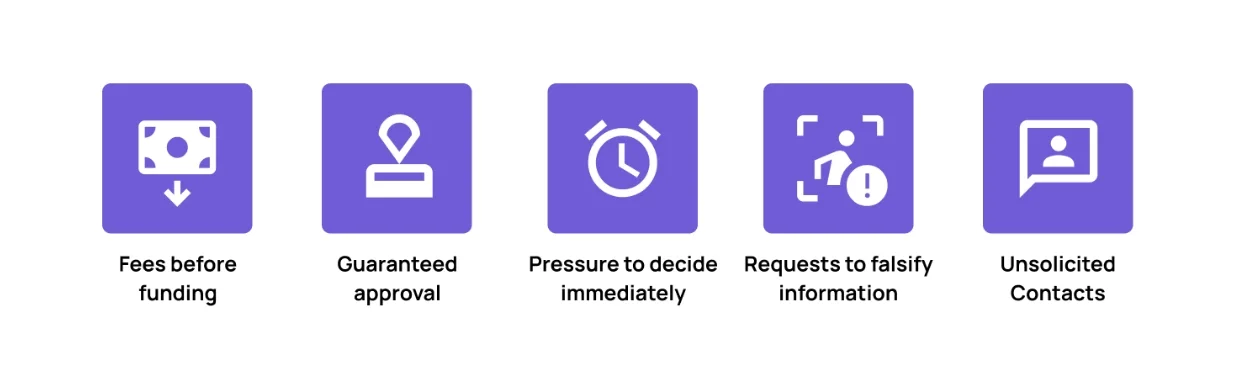
Red flags to watch for:
Upfront fees before funding. Watch out for companies that demand payments before funding your loan — especially if they want you to pay with gift cards, wire transfers, crypto, or other hard to track payment methods.
Guaranteed approval. Legitimate lenders review applications before approving funding, even if it’s just to rule out fraud. If someone guarantees a loan regardless of your credit history, be very skeptical.
Pressure to decide immediately. Scammers create artificial urgency. A legitimate lender will give you time to review the terms before you accept the loan.
Requests to falsify information. A reputable lender should never ask you to misrepresent details about your business or leave signature boxes blank.
Unsolicited contact claiming to be from the SBA. The SBA only communicates from email addresses ending in @sba.gov. Any contact from a different address claiming SBA affiliation is suspicious.
Be especially careful with "no doc" loan offers that also promise bad credit approval, and then ask for an upfront fee. Advance fee loan scams specifically target people who have trouble getting financing elsewhere.