Compare minority business loans: How to apply in 2026

Written byGerri Detweiler
Reviewed by Robin Saks Frankel

Summary
- Minority business owners may find it difficult to find traditional funding for a variety of reasons, including lower credit scores, limited collateral, or reduced revenue.
- Black-owned businesses received 6.5% of SBA 7(a) loan approvals, Hispanic-owned businesses received 11.3%, and Asian-owned businesses received 11.2% while white-owned businesses received 43.1%, in fiscal year 2025. These figures reflect the share of approvals, not approval rates or denial rates.
- True “minority business loans” aren’t common, but there are programs that may help these business owners increase access to capital.
- Small business owners can take proactive steps to find financing — learn how in this guide.
Minority business loans overview
- Most "minority business loans" aren't exclusive government programs: they're standard loan products from lenders who specifically serve underserved markets or provide added support.
- Places to start include SBA-approved lenders, CDFIs, minority depository institutions (MDIs), and state or local programs.
- Credit, cash flow, and documentation still matter regardless of which program you apply through.
- Certifications like MBE and HUBZone are primarily valuable for government contracting access, not for unlocking specific loan products.
- If you have bad credit, you're not out of options: CDFIs and microloans often have more flexible underwriting than conventional banks.
Best for | Best loan type | Runner-up option | Typical funding speed | Typical requirements | Key tradeoff | Watch out for |
Established businesses needing working capital or expansion | SBA 7(a) loan | CDFI term loan | 30–90+ days | Strong financials, acceptable personal credit | Great terms, slower process | Long application timelines |
Startups with limited credit history | Microloan, crowdfunding | CDFI microloan | 2–8+ weeks | Business plan, some credit history | Smaller amounts (up to $50,000) | Use restrictions (can't be used for real estate) |
Businesses in underserved communities | CDFI loan | MDI relationship loan | 2–8+ weeks | Flexible — varies by lender | More flexible underwriting; may include coaching | Terms vary widely by institution |
Businesses rebuilding credit | SBA microloan or CDFI microloan | Vendor accounts + secured credit card | 2–8 weeks | More flexible credit | Smaller loan amounts | Use as a building block, not a growth tool |
Businesses needing capital fast | Online lender | Line of credit | 1–5 business days | Revenue history, some credit | Speed and flexibility | Significantly higher costs than SBA or CDFI loans |
Businesses pursuing federal contracts | SBA 8(a) program or HUBZone certification | State/local contracting programs | N/A — contracting pathway, not a direct loan | Economic disadvantage criteria; program-specific requirements | Contract access, not direct capital | SBA 8(a) program is in flux; verify requirements at SBA.gov |
What is a minority business loan?
Clarifying what a "minority business loan" is (and isn't) is a good place to start. Most of the financing options you'll find under that label fall into one of two categories:
- Standard loan products from lenders who prioritize underserved markets, and
- Programs specifically designed to expand access to capital in communities that have historically faced barriers.
Traditionally, some of the most common places to start have included SBA-approved lenders, CDFIs and microlenders, minority depository institutions, and state or local programs. That has changed recently, though, as we’ll explain in a moment.
Most lenders don't use the phrase "minority business loan" to describe what they offer, and that’s especially true with many DEI programs undergoing policy and legal review.
What makes a loan or program relevant to minority business owners is usually the lender's mission, a program's eligibility criteria, or a geographic or demographic focus, but not an entirely separate class of loan product.
It's also worth knowing that many minority business loan roundup lists online are simply lists of general small business loan products, not vetted programs with minority-specific eligibility because those types of programs are not common.
How to spot marketing vs. reality
Before investing time in any application, check for the following:
- Clear eligibility rules that specify who qualifies and how.
- Term disclosures: Interest rates, fees, and repayment periods should be accessible before you apply; any lender withholding this is a red flag
- Whether the program is tied to a certification, geographic area, or specific demographic: if not, it may be a standard loan with targeted marketing
- A verifiable lender: For example, SBA-approved lenders at sba.gov, CDFI Fund-certified institutions at cdfifund.gov, or FDIC-insured banks at fdic.gov
Are there loans only for minority-owned businesses?
Truly exclusive loan programs available only to minority-owned businesses are uncommon. Most programs described as "minority business loans" are open to any qualified small business owner, but they may prioritize underserved borrowers through their lending mission, flexible underwriting standards, or targeted outreach.
Where you tend to find more exclusive access is in government contracting and procurement programs. Certifications like MBE and the SBA 8(a) program may create pathways to government contracts, not direct loans.
What "priority" looks like in practice:
- Mission-driven lenders (CDFIs, MDIs) are structured to serve borrowers who don't fit conventional bank profiles, which can include some minority business owners
- Specialized programs at the state, local, or nonprofit level may include demographic eligibility requirements
- Contracting programs (8(a), HUBZone, MBE) give certified businesses competitive advantages in government procurement
Regardless of the program, approvals still depend on your credit profile, cash flow, time in business, and documentation. While lenders may allow for more flexibility with minority loan programs, they don’t eliminate those types of requirements altogether.
What qualifies as a minority-owned business?
Most programs follow a common standard: the business must be at least 51% owned and controlled by one or more individuals who are members of a recognized minority group. But definitions can vary by program, and understanding the distinction between "owned," "controlled," and "operated day to day" can make a difference.
- Owned means holding at least 51% of the stock or equity in the business
- Controlled means having actual decision-making authority over the business's strategic direction
- Operated day to day means the minority owner is actively managing the business — not serving as a passive investor or figurehead
Lenders and certifying bodies care about these distinctions because they help prevent businesses from claiming minority status without genuine minority leadership. Simply having a minority owner on paper isn't enough for most programs.
Do you need certification to get a minority business loan?
For most standard loan products, including SBA loans, CDFI loans, MDI loans, and online lenders, certification is not required. You apply the same way any business owner would, and lenders evaluate factors such as your financials and creditworthiness.
Certification matters most in two specific situations:
- Government contracting programs: Certifications like MBE, 8(a), and HUBZone are primarily pathways to federal and corporate contract opportunities, but are not typically prerequisites for loan products.
- Certain state/local initiatives or grant programs: Some economic development programs or private grant competitions require certification as proof of minority ownership.
Even when certification isn't required, it may be worth pursuing for the business development benefits: network access, corporate supplier diversity programs, and in some cases access to specialized funding lanes.
But for most small business owners focused on getting a loan now, certification is usually a secondary consideration. In other words, not being certified doesn’t prevent you from applying for most loans.
Minority business certifications that may unlock funding
Certifications are often tools to build revenue, not to get loans. Certain government contracts are set aside for minority suppliers, and some private organizations also have supplier diversity targets.
In practice, certifications typically help to open three types of doors:
- Government contracting access: federal and state set-aside contract opportunities
- Supplier diversity networks: access to corporate purchasing programs
- Specialized funding eligibility: some state-level loan or grant programs may require verified minority ownership
Certification | Who it's for | What it can unlock | Typical proof needed | Renewal | Common pitfalls |
MBE (NMSDC) | For-profit businesses 51%+ owned by Asian-Indian, Asian-Pacific, Black, Hispanic, or Native American U.S. citizens | Corporate supplier diversity contracts; some private grant eligibility | Ownership docs, government ID, business filings, interviews, site visit | Annual | Incomplete documentation; passive ownership that doesn't reflect day-to-day control |
SBA 8(a) | Eligibility standards for the SBA 8(a) program changed significantly beginning in 2025 and remain under review. | Federal set-aside and sole-source contracts; business development assistance; mentorship | Economic disadvantage documentation; business financials; social disadvantage narrative no longer accepted | Annual | Program in active flux; acceptance dropped to 65 firms in all of 2025; verify at SBA.gov |
DBE (DOT) | Disadvantaged businesses in transportation-related industries: | Federal transportation and infrastructure contract set-asides | State DOT application; ownership verification | Annual or biennial | Relevant only for transportation/construction industries; managed at state level |
HUBZone | Small businesses with principal office in a HUBZone area; 51% U.S. citizen-owned; 35% of employees must live in HUBZone | Federal set-aside contracts; 10% price evaluation preference in full and open competition | Principal office verification; employee residency documentation | Annual | HUBZone map updated July 2023; verify your location and employee residency before applying |
It can take several weeks or even months to complete these certifications, so start early if they are of interest.
MBE certification
Minority Business Enterprise (MBE) certification is issued by the National Minority Supplier Development Council (NMSDC) and is the national standard for private-sector supplier diversity. To qualify, a business must be at least 51% owned, operated, and controlled by a U.S. citizen who identifies as Asian-Indian, Asian-Pacific, Black, Hispanic, or Native American.
Certification involves a rigorous review of documentation, an interview, and a site visit to verify that minority ownership is real and active — not just listed on paper. The process is annual.
The practical value of MBE certification is primarily corporate: NMSDC matches over 15,000 certified MBEs with member corporations seeking diverse suppliers. If your business sells products or services to large companies, this certification can open procurement doors that aren't accessible without it. It also creates a searchable profile in the NMSDC Hub.
MBE certification does not guarantee contracts and is not typically required to access standard loan products.
SBA 8(a) business development program
The SBA 8(a) program is a nine-year business development program that helps small businesses access federal set-aside and sole-source contracts. It also provides one-on-one business development assistance through dedicated Business Opportunity Specialists, access to the SBA Mentor-Protégé program, and management and technical guidance.
The 8(a) program is not a loan, it’s a pathway toward federal government contracting. If you're interested, review current requirements directly at SBA.gov before investing time in an application, as the program remains in active review.
DBE certification
The U.S. Department of Transportation’s Disadvantaged Business Enterprise (DBE) program is a federal program administered at the state level through departments of transportation. It's designed to ensure that socially and economically disadvantaged businesses have meaningful opportunities to participate in federally funded transportation and infrastructure projects.
Because DBE certification is managed at the state level, eligibility requirements, documentation needs, and timelines vary by state. If your business operates in construction, engineering, or transportation-related services and you want to pursue federally funded transportation contracts, contact your state's Department of Transportation to learn about the process in your state.
HUBZone certification
The HUBZone program was designed to help small businesses in economically distressed communities compete for federal contracts. To qualify, your business must be at least 51% owned and controlled by U.S. citizens, have its principal office located in a designated HUBZone area, and have at least 35% of its employees living in a HUBZone.
HUBZone-certified businesses can compete for set-aside contracts and receive a 10% price evaluation preference in full and open federal contract competitions. The federal government has a goal of awarding at least 3% of all federal contracting dollars to HUBZone-certified businesses each year.
The HUBZone map was updated in July 2023 — if you're considering applying, verify that your principal office location and your employees' home addresses currently fall within a qualifying zone before you start the application. You can check at certifications.sba.gov.
Like MBE and 8(a), HUBZone is a contracting tool, not a direct source of capital.
Where to get minority business loans
Not all lenders are built the same, and not all of them are the right fit for every borrower. When you're deciding where to apply, weigh four dimensions: cost, speed, qualifications, and support. For example, if you’re considering an SBA loan, which is considered an attractive option for businesses who have trouble getting financing elsewhere, you can evaluate
- Cost: SBA loans typically offer the most favorable rates and terms, but they take longer to process, and may require strong qualifications.
- Speed: If you need capital in days, an SBA lender isn't the answer; if you can wait weeks to months, that patience usually pays off in cost savings.
- Qualifications: SBA microloans may allow lenders to look beyond the credit score and evaluate other factors besides high personal credit scores.
- Support: Some lenders, particularly CDFIs, pair loans with technical assistance such as business coaching, financial training, and business development resources that can have as big an impact as the loan itself.
SBA-approved lenders and mission-driven SBA lenders
SBA loans are among the most attractive options available to small business owners, who are having trouble getting traditional small business financing. They’re open to any qualified U.S. business, not just minority-owned firms.
What makes them relevant in this context is that several SBA programs are designed specifically to reach underserved markets, and a growing number of mission-driven lenders have become SBA-approved to serve those communities.
SBA loan types to consider:
- SBA 7(a) loan: The SBA's flagship program. Maximum loan amount of $5 million. Can be used for working capital, equipment, real estate, debt refinancing, and more. An SBA 7(a) loan requires strong financials and demonstrated ability to repay.
- SBA 7(a) Small loan: Same as 7(a) but capped at $350,000, with somewhat streamlined processing.
- SBA Express loan: Faster decisions from the SBA (typically within 24 to 48 hours). SBA Express loans are up to $500,000. Same eligible uses as 7(a).
- SBA microloan: Loans up to $50,000 made through nonprofit community-based intermediaries. The average SBA microloan was about $16,000 in fiscal year 2025. Repayment up to seven years. Often includes technical assistance. A strong option for startups and borrowers with lower credit scores.
- Community Advantage (CA): Loans up to $350,000 through mission-oriented lenders focused on economic development and underserved markets.
SBA readiness checklist
Before applying, make sure you:
- Qualify as a small business based in the U.S. owned by U.S. citizens
- Operate in an industry that’s not prohibited by the program
- Have good personal credit (usually scores of 640 or higher; 680–700+ is often preferred)
- Cash flow sufficient to service the debt, or projections to support how you will achieve that
- A clear, documented use of funds
Learn more about SBA loan requirements here
CDFIs and nonprofit microlenders
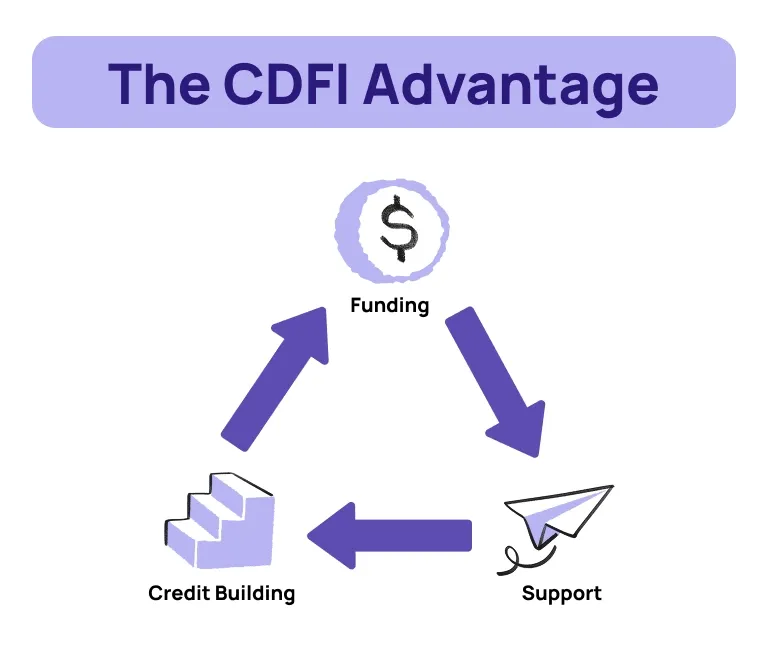
Community Development Financial Institutions (CDFIs) are certified by the U.S. Department of the Treasury and may be banks, credit unions, loan funds, or venture capital funds, all structured to expand economic opportunity in low-income, rural, and underserved communities. There are more than a thousand certified CDFIs operating across all 50 states, the District of Columbia, Guam, and Puerto Rico.
There are three ways these organizations are often unique:
- The loan size. They may make loans that are too small to be attractive to banks or other traditional lenders.
- The underwriting approach. Where a conventional bank focuses heavily on credit scores, collateral, and financials, a CDFI may be able to consider alternative factors such as your cash flow, your market, your community ties, and your business plan.
- The final difference is support. CDFIs often pair loans with coaching, financial education, and other types of technical assistance which can prove valuable to very small businesses.
Minority depository institutions
Minority depository institutions (MDIs) are FDIC-insured banks or savings associations where at least 51% of the voting stock is owned by minority individuals, or where the majority of the board of directors is minority and the community served is predominantly minority. As of Dec. 31, 2025, there are 154 FDIC-insured MDIs with headquarters across the United States. These banks have 1,437 branches, and a combined asset total of over $388 billion.
MDIs are often anchor institutions in their communities. They're built to serve borrowers who may not feel seen or served by conventional banking institutions, and their lending often reflects that mission. An MDI may have more context for your specific community's economic conditions, stronger relationships with local business owners, and more flexibility in how they evaluate a loan application.
What to ask when you reach out to an MDI
- Do you have specific lending programs for minority-owned or underserved small businesses?
- What's your minimum time-in-business requirement for a business loan?
- Do you require an existing banking relationship before approving credit?
- What documentation do you typically need upfront for a business loan application?
You can find FDIC-insured MDIs using the interactive map and directory at fdic.gov.
Banks and credit unions with diversity programs
Some conventional banks and credit unions have dedicated programs for minority-owned or underserved businesses, often tied to Community Reinvestment Act (CRA) commitments or voluntary equity initiatives. These can include reduced rates, expedited processing, or dedicated relationship managers.
The key to making these work is a banking relationship. Lenders who know your business — your deposit history, cash flow patterns, and track record — may be able to make faster decisions than those evaluating your application from scratch.
How to build a banking relationship that supports future lending
- Open a dedicated business checking account and maintain it cleanly, with no overdrafts and with consistent deposits
- Run business revenue through your business account, not personal accounts
- Keep your bookkeeping organized and up to date
- Meet with your banker (if possible) regularly and not just when you need something
- Ask about smaller credit-building products (secured business credit cards, small lines of credit) before you need a large loan
State, local, and tribal lending programs
State, local, and tribal programs may be overlooked, even though they can offer compelling terms, especially for businesses in specific industries, communities, or development zones. These programs typically live inside state economic development agencies, city and county small business offices, and tribal business development centers.
These programs tend to be smaller and very local, so it can take some legwork to figure out which ones are a fit for your Native-owned business. You may want to look to SBA resource partners or the SBA Office of Native American Affairs (sba.gov) for help finding programs that may be available to you.
Online lenders and marketplaces
If you qualify, many online lenders can fund your business in days, and sometimes the same day. But that speed often comes with higher costs than more traditional loans. Daily or weekly repayments may be required, and may come right out of your business bank account or merchant account.
That doesn't make them wrong for every situation. If you have a short-term cash flow gap, a time-sensitive opportunity with a clear return, or no other options while you work toward qualifying for better products, online lending may bridge the gap. But choose carefully and talk with your accountant or business mentor about whether it makes sense for your situation.
Also, to be clear, some online lending products can be quite competitive, and qualifications will be different from one lender to the next.
When online lending can make sense
- You need capital faster than traditional lenders can provide
- The business opportunity clearly and specifically justifies the cost of the loan
- You've compared at least two to three offers and understand the true total cost
When to look elsewhere first
- You have two to four weeks to apply for a lower-cost product
- You're already carrying significant debt
- The repayment frequency would put consistent pressure on your cash flow
For an approach to compare loan offers against alternatives, see the offer comparison section below.
Minority business grants and other non-loan funding
Grants and crowdfunding can play a meaningful role in your funding strategy, but they aren’t an option for all businesses, and when they are, there is often a good amount of work involved in applying.
Most grants aimed specifically at minority business owners come from state, local, or private sources. They're almost always competitive, at least somewhat narrow in scope, and have very specific deadlines. (Many of these grants open up for applications once a year.)
Grants for minority-owned businesses
If you’re looking for a grant for your minority-owned business, you’ll want to look at federal, state, and private grants. Again, these programs are competitive.
How to search for minority business grants
- Start with credible databases: Grants.gov for federal opportunities; your state's economic development website for state and local programs, GrantWatch.com and OpenGrants.io for various types of grants.
- Connect with your local SBDC, SCORE chapter, or MBDA Business Center, who may know about programs not listed in public databases. Your local librarian may be able to help you search for grants as well.
Red flags that may signal a grant scam
- "Guaranteed approval" language — no legitimate grant program guarantees awards to any applicant
- Vague or nonexistent eligibility requirements
- No verifiable connection to a government agency, accredited nonprofit, or established corporation
- Grants with significant fees for applying or for processing an award
Crowdfunding and peer-to-peer lending
Crowdfunding isn't a passive fundraising strategy. It requires an existing audience, a compelling story, and often a real marketing campaign. But when it works, it can raise money for your business, often without debt or without giving up any ownership. When it doesn't work, you may feel like you’ve wasted your time and money with nothing to show for it.
Main types of crowdfunding
- Rewards-based (e.g., Kickstarter, Indiegogo): Raise money by offering a product or experience in return. Rewards-based crowdfunding works best for product-based businesses with a story that resonates publicly and an existing audience to mobilize.
- Loan-based / peer-to-peer (e.g. Kiva, Honeycomb Credit): Borrow money and repay it. Kiva offers 0% loans to eligible small businesses through a community-vetting process, and it's often accessible to borrowers with limited credit history.
- Equity crowdfunding: Raise capital by offering ownership stakes to a broad pool of investors. Equity crowdfunding is more complex, requires legal compliance, and is better suited for businesses at a defined growth stage.
- Donation-based (GoFundMe): Raise money without repayment. Better for community-specific or cause-related needs than standard business operations.
What to consider before you launch a crowdfunding campaign
- How will you reach people? Do you have an email list, social media following, or community that will actively back the campaign?
- How much can you raise? Is your funding goal realistic given what your audience can actually support?
- Are you ready for the work? Do you have bandwidth to run a marketing effort alongside the campaign itself?
- What happens if you don’t reach your goal? What's your plan if you reach only 50% of your goal, for example? How can you recycle the work you put into the campaign (for example, for small business grants)?
How to qualify for a minority business loan
Applying for a small business loan can be intimidating. But whether you're applying through an SBA lender, a CDFI, or an online platform, lenders often evaluate a core group of factors.
Understanding where you stand before you apply may save time and even improve your likelihood of approval.
What lenders often evaluate
- Personal credit scores: Personal credit checks are common for many types of small business loans. Many lenders look for scores of 640 or higher; 680 to 700+ is often preferred for competitive terms. CDFIs and SBA microloans are more flexible but still review personal credit.
- Business credit: Some lenders may check business credit. A combination of strong business credit and personal credit may expand financing options.
- Time in business: Lenders often prefer at least two years in business, though some options are available to startups.
- Revenue and cash flow: Lenders often require business bank statements, tax returns, and/or financial statements to verify revenue and ability to repay the loan.
- Use of funds: Make sure you know how you plan to use the money and that it matches with the type of funding you’re looking for. Short-term financing should be used for short-term capital gaps, for example.
- Collateral: Some lenders will take an interest in all available collateral and file a UCC lien to protect their interest. If you don’t have collateral or don’t want to pledge it, you’ll need to look for unsecured financing.
Watch: Funding that fits: How to find small business financing that fits your business.
[Video not available in print]
How to apply for a minority business loan
Every lender has its own application process, but here are the main ways you can prepare for this process:
Step 1: Know your numbers before you apply
Review your personal and business credit reports before any application. (You can check both through Nav.)
You don’t have to do this, of course, as the lender will pull credit if it requires credit checks. But by taking this step, you can look for errors, outdated accounts, or negative items you can address before a lender sees them.
Also make sure your business bookkeeping is up to date so you can supply any required financial data.
Step 2: Match the loan type to your situation
Use the overview table at the top of this article to narrow down which lender type and loan product aligns with your current credit profile, time in business, and funding need. Applying to a program you don't qualify for wastes time and may generate unnecessary credit inquiries.
Step 3: Gather your documentation
Gathering these documents ahead of time so they are easily available can speed up your application process.
- Business bank statements (typically the most recent three to six months)
- Business licenses and organizational documents
- Social Security number and/or employer identification number (EIN)
- Business and personal tax returns (typically two to three years)
- Profit and loss statements and/or balance sheets
- A business plan or written description of how you'll use the funds
Step 4: Apply and follow up
Online lenders and business credit card issuers have streamlined applications that may take minutes. SBA applications through an approved financial institution can take weeks or months.
Respond promptly to requests for additional documentation, and follow up if you don’t hear back.
Step 5: Understand what you're signing
Before accepting any offer, review the full terms: interest rate (fixed or variable?), fees, prepayment provisions, collateral requirements, and whether a personal guarantee is required. For SBA loans, personal guarantees are required from all owners with at least 20% equity — meaning if your business defaults, your personal assets can be at risk.
How to compare offers and avoid expensive debt traps
Rates can help you compare financing options. Payments can help you figure out whether you can afford the loan. Both are important and if you ignore one or the other, you may wind up with a loan you regret.
Two loans with the same rate can have dramatically different total costs depending on how costs are structured, how frequently you make payments, and whether there are prepayment penalties.
Use this worksheet to help compare offers side by side:
What to do if you have bad credit or get denied
Bad credit is a real barrier to qualifying for many types of financing but it doesn’t necessarily have to be a permanent one, and it doesn't have to exhaust all your options.
If you have bad credit, here's where to start
- Get your free personal credit reports at AnnualCreditReport.com and check personal and business credit through Nav.
- Look into microloans as qualifications are more flexible than standard term loans, and startups may be eligible.
- Consider a secured credit card or credit-builder account to begin building or rebuilding personal credit.
- Get vendor accounts (net-30 accounts) to manage cash flow and/or build business credit. Many don't check personal credit, so you can build business credit while working on personal.
- If your business revenue is strong, consider cash flow financing options
- Reach out to a CDFI: Underwriting may take a more flexible approach than conventional banks.
As you make on-time payments on accounts that report to business credit, you can help build a credit profile that may make you a stronger candidate for certain traditional business loans.
Resources for minority-owned businesses
Here are resources that may be helpful in your search:
Organization | How it helps | Best for |
Small Business Development Centers (SBDCs) | Free one-on-one business consulting and low-cost training across nearly 1,000 locations nationwide | Any stage; especially useful for loan preparation and financial organization |
SCORE | Free mentorship from experienced business volunteers; the nation's largest business mentor network | Entrepreneurs who want ongoing guidance from someone with industry experience |
Minority Business Development Agency (MBDA) | Helps minority businesses access capital, contracts, and global markets; organizes grant competitions and funding opportunities | Minority-owned businesses seeking contracts, capital connections, and market access |
SBA Office of Native American Affairs (ONAA) | Resources for Native American, Alaska Native, and tribal businesses including program guidance and tribal-specific programs | Native American or tribal business owners |
CDFI Fund locator | Directory of mission-driven lenders near you at cdfifund.gov | Any business looking for flexible, community-based lending options |
FDIC MDI locator | Find FDIC-insured minority depository institutions near you at fdic.gov | Businesses seeking a mission-aligned banking partner |
Nav | Check personal and business credit overview for free; find matched financing options; can support building business credit through Nav Prime | Any small business owner at any stage of the credit journey |
Nav is not a lender or a credit bureau. Credit information is provided by third-party sources.